
Executive Summary
For most drivers in Glasgow and Central Scotland, all-season tyres are the most practical choice for our winters, while dedicated winter tyres make sense for those who drive in more rural, hilly or exposed areas or who cannot afford to be caught out. Standard summer tyres lose a lot of their grip once the temperature drops below about 7 degrees Celsius, which in Scotland is most of the colder half of the year, so relying on them through winter is a real compromise.
The reason is not just snow, which is relatively rare in the central belt. It is cold, wet, greasy roads, which we have in abundance. Winter and all-season tyres use a different rubber compound and tread pattern that stays flexible and grips in exactly those conditions.
This guide explains the three options, when each makes sense for Scottish conditions, and how to decide, without overselling something you may not need.
Disclaimer: Tyre choice depends on where and how you drive. This is general guidance for Scottish conditions, not a recommendation for a specific vehicle. Always fit tyres that meet your vehicle’s specification.
Why Standard Tyres Struggle in a Scottish Winter
The key fact most drivers do not know is about temperature, not snow.
Standard summer tyres are made from a rubber compound optimised for warmer conditions. Once the air temperature drops below roughly 7 degrees Celsius, that compound hardens, and a harder tyre grips the road less well. Braking distances lengthen and grip in the wet drops off, even on a clear, snow-free road.
In Scotland, temperatures sit below 7 degrees for a large part of the year, often from around October through to April. So for roughly half the year, a standard summer tyre is working below its best every time you drive, regardless of whether there is any snow or ice. That is the real Scottish winter problem: not blizzards, but months of cold, wet, greasy roads where summer rubber simply grips less.
This is why the choice of winter or all-season tyres matters here more than the relatively rare snowfall would suggest.
The Three Options
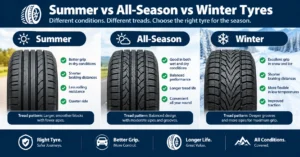
Standard (summer) tyres
What most cars come on. Excellent in warm, dry and wet conditions, and usually the quietest and most economical. Their weakness is cold: below 7 degrees they harden and lose grip. Fine for a garaged car used mainly in warmer months, a compromise as an all-year tyre in Scotland.
All-season tyres
The practical middle ground, and for most central-belt drivers the sensible answer. All-season tyres use a compound and tread designed to work across a wide temperature range, so they stay grippier than summer tyres in the cold and wet without the downsides of full winter tyres in summer. You fit them once and forget about seasonal changes. They will not match a dedicated winter tyre in deep snow, but for Glasgow’s cold-and-wet reality they are a strong all-round choice.
Winter tyres
The specialist option. A soft compound and deep, siped tread designed for cold, snow and ice, marked with a snowflake symbol. They grip best of all in genuine winter conditions. The trade-offs are that they wear faster and grip less well in warm summer conditions, so they are meant to be swapped on for the cold months and off again in spring, which means storing a second set. Best suited to rural, hilly or exposed routes, or drivers who genuinely cannot risk being caught out.
Whichever route you choose, our seasonal tyre change service can fit and swap them at your home, so you are not hauling wheels to a garage.
Which Should You Choose in Central Scotland?
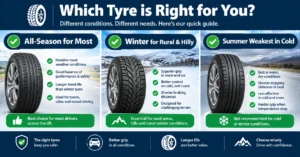
A straightforward way to decide, based on how and where you drive.
All-season tyres suit most Glasgow and central-belt drivers. If you mostly drive in and around the city and towns, on gritted main roads, and want one set of tyres that copes with our long cold-and-wet season without the faff of swapping, all-season is the pragmatic choice.
Winter tyres suit exposed and rural drivers. If you regularly drive rural South Lanarkshire, the roads out toward the Campsies, hilly routes, or anywhere that is late to be gritted and quick to ice, dedicated winter tyres for the cold months are worth the extra effort and storage.
Standard tyres are the weakest winter option, but if your car is little used in the cold months, or garaged, you may accept the compromise. Just know that you are driving below the tyre’s best whenever it is cold.
There is no single right answer, only the one that fits your driving. What matters most of all, whatever type you run, is that the tread is legal and healthy going into winter, which our guide on tyre tread depth explains, because worn tyres are dangerous in the cold and wet regardless of type.
The One Thing That Matters More Than Type
Before spending on a particular tyre type, get the basics right, because they matter more than the summer-versus-winter debate.
Tread depth. Grip in the wet falls off sharply as tread wears, and Scottish winter roads are wet far more than snowy. A tyre near the 1.6mm legal limit is a poor performer in exactly our conditions, whatever its type. Going into winter with healthy tread is the single most important thing.
Correct pressures. Cold air lowers tyre pressure, so pressures that were fine in summer can drop below the mark in winter, worsening grip and wear. Check them as the temperature falls.
Even wear and condition. Uneven wear or ageing, cracked rubber undermines grip in the cold. If in doubt, have them inspected.
Get those right and you have solved most of the winter grip problem. The tyre-type choice then fine-tunes it for your particular driving.
Frequently Asked Questions
What are the best tyres for a Scottish winter? For most Glasgow and central-belt drivers, all-season tyres are the most practical choice, coping with our long cold-and-wet season without seasonal swaps. Dedicated winter tyres are better for rural, hilly or exposed routes. Standard summer tyres are the weakest winter option because they harden and lose grip below about 7 degrees.
Do I really need winter tyres in Scotland? Not necessarily. Snow is relatively rare in the central belt, so many drivers are well served by good all-season tyres. Dedicated winter tyres make most sense if you regularly drive rural, hilly or exposed roads that ice up and are gritted late. The bigger issue than snow is months of cold, wet roads.
Why do standard tyres grip less in winter? Standard summer tyres use a rubber compound optimised for warmer weather. Below about 7 degrees Celsius that compound hardens, which reduces grip and lengthens braking distances, even on a clear, snow-free road. In Scotland, temperatures are below that threshold for much of the year.
What is an all-season tyre? An all-season tyre uses a compound and tread pattern designed to work across a wide temperature range, staying grippier than a summer tyre in cold and wet without the summer downsides of a full winter tyre. It lets you fit one set year-round, which suits most central-belt driving.
When should I switch to winter tyres? If you use dedicated winter tyres, the usual guidance is to fit them as temperatures fall consistently below about 7 degrees, typically around October or November, and swap back in spring. All-season tyres remove the need to switch at all, which is why many drivers prefer them.
Conclusion
The best tyres for Scottish winters for most drivers are all-season tyres, which handle our long cold-and-wet season without seasonal swapping, while dedicated winter tyres suit rural, hilly and exposed routes. Standard summer tyres are the weakest winter option, because they harden and lose grip below 7 degrees, which in Scotland is most of the colder half of the year.
Whatever you choose, healthy tread and correct pressures matter most. When you are ready to fit winter or all-season tyres, our seasonal tyre change comes to your home across Glasgow, with no call-out fee.