
Executive Summary
Part-worn tyres look cheaper, but they usually are not once you count the reduced life you are buying, and they carry real safety and quality risks. A part-worn tyre is a used tyre with some tread already gone, often sold with only a few millimetres remaining, which can mean paying a large share of a new tyre’s price for a fraction of its remaining life. On a cost-per-millimetre-of-tread basis, part-worns are frequently more expensive than new budget tyres.
Beyond cost, there are safety concerns: a used tyre may have hidden internal damage, previous poor repairs, or age-related weakness that is not visible. There are strict rules for selling them, but not all sellers follow them.
This guide explains what part-worn tyres are, the real economics, the risks, and why a new budget tyre is often the better buy.
Disclaimer: General guidance. If you do buy part-worn tyres, ensure they meet the legal requirements for sale and have them inspected. When in doubt, a new tyre is the safer choice.
What Are Part-Worn Tyres?
A part-worn tyre is simply a used tyre being resold. They come from various sources: tyres taken off written-off or scrapped cars, tyres removed when someone upgraded, or imported used tyres from other countries.
They are legal to sell in the UK, but only if they meet specific requirements. A legally sold part-worn must have at least 2mm of tread across the full width, must be free of certain damage, must have any repairs done to the proper standard, and must be permanently and legibly marked with the words “PART WORN” in letters of a set size. Crucially, a compliant seller should also point out that these are used tyres.
The problem is that not all sellers follow these rules. Investigations over the years have repeatedly found part-worns sold with dangerous damage, sub-standard repairs, or without the required markings. So while a properly sold, carefully inspected part-worn can be legal, the market has genuine quality-control issues that put the burden of caution on you.
The Real Economics: Why the Saving Often Isn’t Real
Here is the point most part-worn buyers miss, and it is about value, not sticker price.
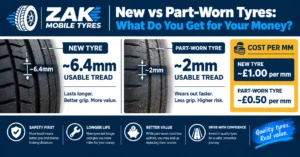
A new tyre starts with around 8mm of tread and is legal down to 1.6mm, so you get roughly 6.4mm of usable tread. A part-worn is often sold with around 3 to 4mm of tread, giving you perhaps 2mm of usable tread before it is illegal. So you might be buying less than a third of the usable life.
Now look at the price. Part-worns are frequently sold at not far off half the price of a new budget tyre, sometimes more. So you could be paying, say, half the price for under a third of the life. On a cost-per-millimetre basis, that makes the part-worn more expensive per mile driven than a new budget tyre, not cheaper.
Investigations by consumer and safety bodies have made exactly this point: once you account for remaining life, part-worns typically work out dearer than new budget tyres. The saving is an illusion created by looking only at the upfront number. If budget is the concern, a new budget or mid-range tyre, covered in our guide on budget vs premium tyres, is usually the smarter spend.
The Safety Risks
Cost aside, the safety concerns are the bigger reason for caution.
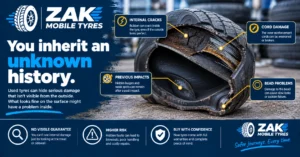
Hidden internal damage. A used tyre may have been driven while underinflated, kerbed, or subjected to impacts that caused internal damage invisible from the outside. You have no history for it. The previous owner’s flat that was driven on could be your blowout.
Poor previous repairs. A part-worn may carry a repair that does not meet the proper standard, or an external plug where a proper internal repair was needed. You often cannot tell by looking.
Age. Tyres degrade with age regardless of tread, as the rubber hardens and can crack. A part-worn with plenty of tread might still be years old, with rubber past its best. Our guide on how tyre age affects safety explains why this matters.
Uneven or unknown wear. The wear pattern on a used tyre can hint at alignment or mechanical problems on its previous car, and mismatched part-worns can upset your car’s balance.
None of this means every part-worn is dangerous, but it means you are taking on unknowns that a new tyre does not carry. For a safety-critical component, that is a meaningful trade-off for a saving that, as shown above, is often not even real.
Frequently Asked Questions
Are part-worn tyres worth buying?
Usually not. Once you account for the reduced remaining tread, part-worns often cost more per mile than a new budget tyre, so the saving is frequently an illusion. They also carry safety risks from hidden damage, poor previous repairs and age. A new budget or mid-range tyre is generally the better buy.
Are part-worn tyres legal in the UK?
Yes, if sold correctly. A legally sold part-worn must have at least 2mm of tread across the full width, be free of certain damage, have any repairs to the proper standard, and be permanently marked “PART WORN”. However, not all sellers follow these rules, so buyers need to be cautious.
How much tread does a part-worn tyre have?
Often around 3 to 4mm, compared with about 8mm on a new tyre. Since tyres are illegal below 1.6mm, a part-worn may give you only around 2mm of usable tread, a fraction of a new tyre’s life, which is why the apparent saving usually is not real.
Why are part-worn tyres cheaper?
Because they are used, with much of their life already gone. The upfront price is lower, but you are buying far less remaining tread, so the cost per mile is often higher than a new budget tyre. The low sticker price hides the poor value.
Is it safer to buy a new budget tyre or a part-worn?
Generally a new budget tyre. It comes with full tread, a known history, no hidden damage or old repairs, and fresh rubber, and it often works out cheaper per mile than a part-worn once remaining life is counted. For a safety-critical part, the known quantity is usually worth it.
Conclusion
Are part-worn tyres worth it? Usually not. The upfront saving tends to vanish once you count the small amount of usable tread you are buying, often making them dearer per mile than a new budget tyre, and they carry real risks from hidden damage, sub-standard repairs and age that a new tyre does not. Properly sold and carefully inspected, a part-worn can be legal, but the market has genuine quality problems.
If cost is the concern, a new budget or mid-range tyre is usually the smarter, safer spend. Our car tyre replacement brings new tyres from budget to premium to your door across Glasgow, with honest advice and no call-out fee.