
Executive Summary
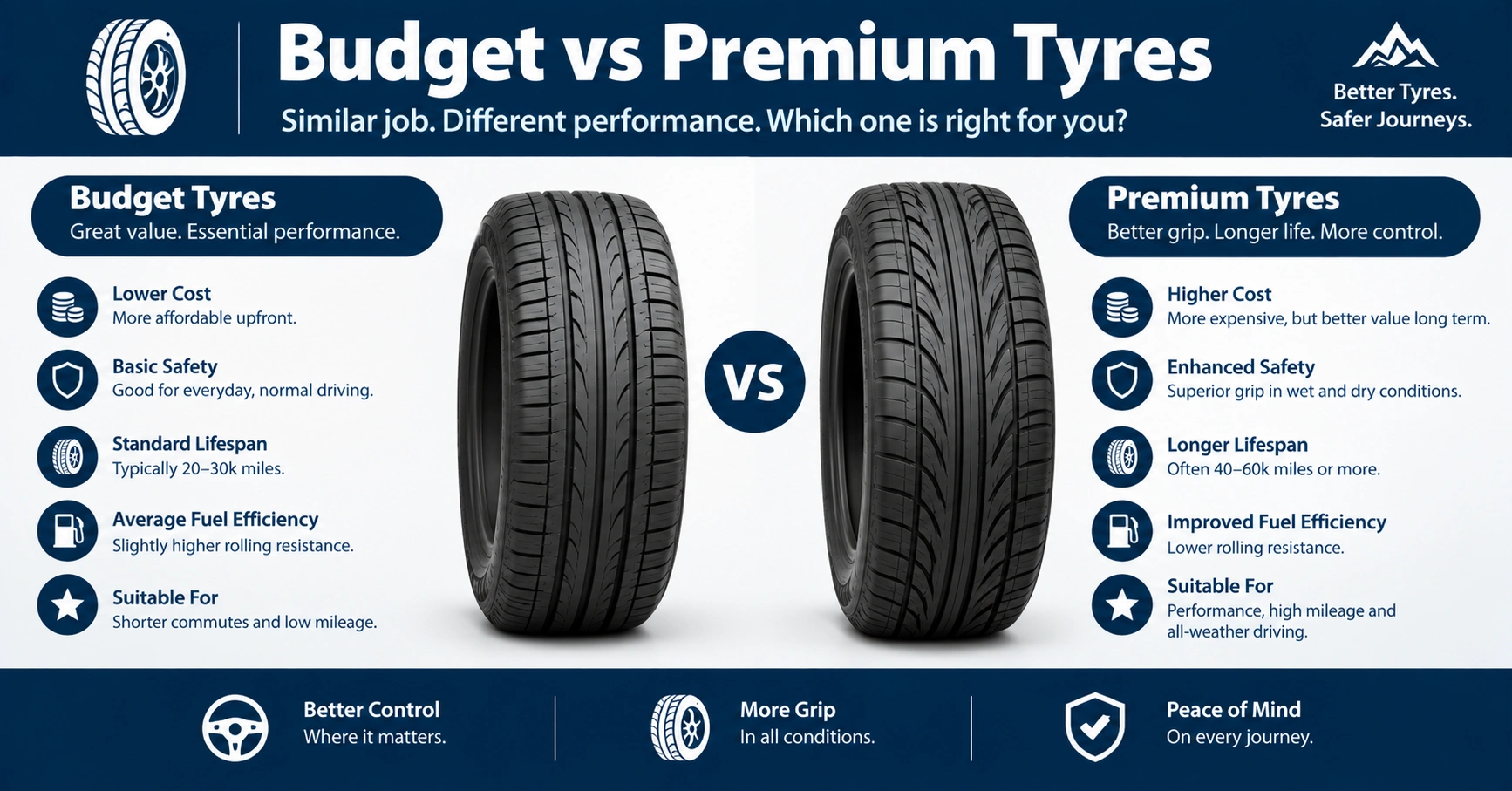
The real difference between budget and premium tyres shows up most in wet braking, grip at the limit, tread life and noise. Premium tyres from makers like Michelin, Continental and Pirelli generally stop shorter in the wet, last longer and run quieter, which is why they cost more. Budget tyres are cheaper upfront and are legal and roadworthy, but they typically give up ground on wet performance and longevity.
That does not make budget tyres the wrong choice for everyone. For a low-mileage second car used mainly around town, a good budget tyre can be sensible value. For high-mileage driving, motorways, or anyone who prioritises wet-weather safety, which matters a great deal in Scotland, premium usually earns its extra cost over the life of the tyre.
There is also a strong middle ground: mid-range tyres that capture much of the premium performance at a lower price. This guide explains the genuine differences so you can choose on evidence, not marketing.
Disclaimer: All tyres sold for road use in the UK must meet legal safety standards. Budget does not mean unsafe. This is general guidance on relative performance and value, not a rating of specific brands.
First, an Important Point: Budget Does Not Mean Unsafe
Before comparing, one thing needs to be clear, because it worries people.
Every tyre legally sold for road use in the UK must meet minimum safety standards. A budget tyre is not an unsafe or illegal tyre. It has passed the same basic legal requirements as any other. So the budget-versus-premium question is not “safe versus dangerous,” it is about degrees of performance and value, particularly at the limits, in the wet, and over time.
With that established, the differences below are real and worth understanding, but nobody should think they are driving on something illegal because it is a budget tyre. The choice is about how much performance and longevity you want for your money.
Where the Real Differences Show Up
Four areas separate budget from premium, and they matter to different degrees depending on how you drive.
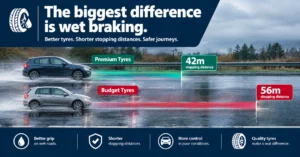
Wet braking and grip. This is the biggest and most important gap. Premium tyres are engineered with advanced compounds and tread designs that clear water and grip in the wet far better, which can mean noticeably shorter stopping distances in an emergency. On Scotland’s perpetually wet roads, this is the difference that matters most, and it is a safety difference, not just a comfort one.
Tread life. Premium tyres generally last longer, using harder-wearing compounds and better construction. A premium tyre that lasts substantially longer than a cheap one can work out similar or better value per mile, even at a higher upfront price. This is where the sticker price misleads people.
Noise and comfort. Premium tyres are usually quieter and smoother, the result of significant engineering. Budget tyres can be noticeably noisier at speed. For motorway drivers this is a real quality-of-life difference.
Grip at the limit and in the dry. In hard cornering, sudden manoeuvres and high-speed stability, premium tyres generally hold on better. For everyday gentle town driving you may rarely reach that limit, but it is there when you need it in an emergency.
When Budget Makes Sense, and When Premium Does
Neither is simply “better.” It depends on your driving.
Budget can be the sensible choice if you drive low mileage, mostly gentle town journeys, on a second car or an older vehicle you will not keep long. In that use, you may never exploit a premium tyre’s extra grip, and the upfront saving is real. A good budget tyre from a reputable maker is fine here.
Premium usually earns its cost if you drive high mileage, spend time on motorways, value the shortest wet braking distances, or simply want the quietest, longest-lasting tyre. Over the life of the tyre, the better wear and wet safety often justify the price, especially in Scottish conditions where wet grip is in constant demand.
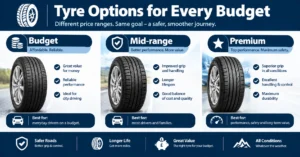
Mid-range tyres are the smart compromise many drivers miss. Tyres a step below the top premium brands often capture most of the wet performance and longevity at a lower price, which can be the best value of all. When we supply tyres, we help you choose across budget, mid-range and premium based on your actual driving, not on selling you the dearest option. Our car tyre replacement and mobile tyre fitting both come with honest advice on which tier suits you.
How to Judge Value Properly
The mistake most people make is comparing the sticker price instead of the cost per mile and the safety per pound.
Think cost per mile, not upfront cost. A premium tyre costing more but lasting substantially longer can be similar or cheaper per mile driven. Divide the price by the realistic mileage to compare fairly.
Weigh the wet braking as safety, not luxury. In an emergency stop on a wet Scottish road, a shorter stopping distance is not a nice-to-have. Put a value on it accordingly.
Match the tyre to the car and use. A powerful or heavy car makes more of a premium tyre’s abilities; a light town runabout makes less. Buy for how you actually drive.
Do not mix wildly across an axle. Fitting a budget tyre alongside a premium one on the same axle unbalances grip. If budget is your choice, apply it consistently. Reading your tyre numbers helps you match correctly.
Judged this way, the choice becomes clear for your situation, rather than a simple “cheap versus dear.”
Frequently Asked Questions
Are budget tyres safe? Yes, in the sense that every tyre legally sold for UK road use meets minimum safety standards, so a budget tyre is legal and roadworthy. The difference from premium is in degrees of performance, especially wet braking, grip at the limit, tread life and noise, rather than safe versus unsafe.
Is it worth paying for premium tyres? Often yes, if you drive high mileage, use motorways, or prioritise the shortest wet braking distances, because premium tyres generally stop shorter in the wet and last longer, which can justify the cost per mile. For low-mileage town driving on a second car, a good budget or mid-range tyre may be better value.
What is the biggest difference between budget and premium tyres? Wet braking and grip. Premium tyres use advanced compounds and tread designs that clear water and grip better, often meaning noticeably shorter stopping distances in the wet. On Scotland’s wet roads this is the most important difference, and it is a safety one, not just comfort.
Are mid-range tyres a good compromise? Yes, and they are often overlooked. Mid-range tyres frequently capture most of a premium tyre’s wet performance and longevity at a lower price, which can make them the best value of all. A good fitter will help you weigh budget, mid-range and premium against how you actually drive.
Can I mix budget and premium tyres on my car? You should avoid mixing them on the same axle, as different grip levels unbalance the car. It is better to keep a matched pair across each axle. If budget is your choice, apply it consistently rather than pairing a cheap tyre with a premium one.
Conclusion
The difference between budget and premium tyres is real and shows up most in wet braking, tread life, noise and grip at the limit. Premium tyres cost more but often justify it through better wet safety and longer life, particularly for high-mileage or motorway driving in wet Scottish conditions. Budget tyres are legal and can be sensible value for low-mileage town use, and mid-range tyres are an often-overlooked sweet spot.
Whatever tier suits you, we help you choose honestly. Our car tyre replacement brings budget to premium options to your door across Glasgow, with advice based on your driving and no call-out fee.