
Executive Summary
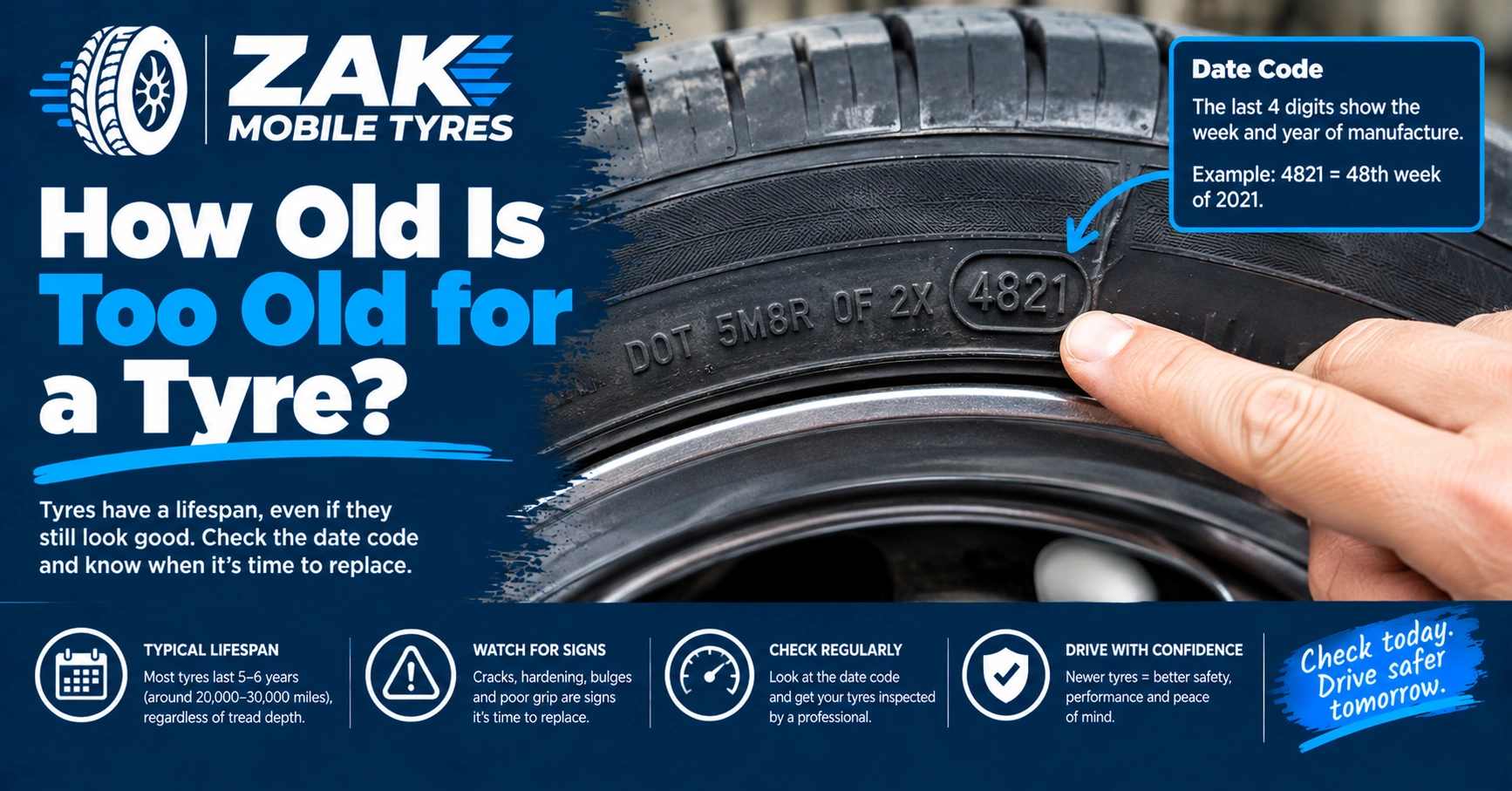
Tyres age and become less safe even if they have plenty of tread left, because the rubber hardens and can crack over time whether the car is driven or not. As a general guide, many manufacturers and safety bodies suggest considering replacement at around 6 years old and treating 10 years as a firm upper limit, after which a tyre should be replaced regardless of how it looks. You can find your tyre’s age from the four-digit date code on the sidewall.
This matters most for low-mileage cars, classic and second cars, caravans, and any vehicle where tyres wear out slowly, because those tyres can reach an unsafe age long before they wear down. An old tyre with deep tread can still be dangerous.
This guide explains how tyres age, how to read the date code, when age becomes a safety issue, and who should pay particular attention.
Disclaimer: General guidance. Age thresholds are advisory, not a strict legal limit for most vehicles. Have older tyres inspected, and when in doubt, replace.
Why Tyres Age Even Without Being Used
It is natural to think a tyre only wears out from driving. In fact, tyres degrade with time as well as use, through a process that continues even on a parked car.
Tyre rubber is a complex compound designed to stay flexible and grippy. Over the years, exposure to oxygen, heat, sunlight and the simple passage of time causes the rubber to harden and lose flexibility, and to develop tiny surface cracks, sometimes called crazing or perishing. A hardened, cracked tyre grips less well, especially in the wet, and is more prone to sudden failure.
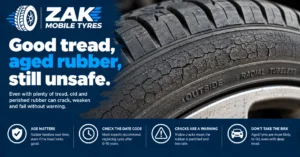
Crucially, this happens regardless of tread depth. A tyre can have most of its tread remaining, look almost new, and still be unsafe because the rubber itself has aged. This is the opposite of the usual worn-tread problem, and it catches out drivers who assume plenty of tread means a healthy tyre.
Storage conditions affect the rate, tyres kept in heat or sunlight age faster, but no tyre lasts indefinitely, which is why age matters alongside wear.
How to Read Your Tyre’s Age
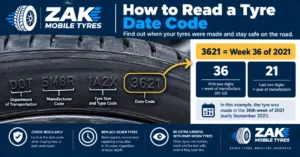
Every tyre carries its date of manufacture, and reading it takes seconds once you know how.
Look on the sidewall for the DOT code, a sequence ending in a four-digit number. Those four digits are the date: the first two are the week of the year, and the last two are the year. So 3621 means the tyre was made in the 36th week of 2021. A code reading 0819 means the 8th week of 2019.
One thing to watch: on some tyres the full date code is only on one side, so you may need to check the inner sidewall. And on a used or part-worn tyre, the date code tells you something the seller may not, that a tyre with good tread could still be years old.
Once you know the date, you know the age, and you can judge it against the guidance below. It is worth checking the date on any car you have bought used, and on any vehicle that covers low mileage, because those are exactly the cases where an old tyre hides in plain sight.
When Age Becomes a Safety Issue
There is no single legal age limit for tyres on most private cars, but there is clear advisory guidance.
Around 6 years: many manufacturers and safety organisations suggest that from about six years old, a tyre should be inspected regularly and replacement considered, as ageing begins to tell.
10 years as a firm limit: the widely accepted upper limit is ten years. A number of tyre makers and safety bodies advise that tyres over ten years old should be replaced regardless of tread or appearance, because the risk of age-related failure is too high. Some vehicles and uses have stricter rules.
The signs to act on sooner: visible cracking or crazing in the sidewall or tread grooves, a hardened or brittle feel to the rubber, or any perishing means replace now, whatever the age. Age guidance is a backstop; visible deterioration overrides it.
If your tyres are approaching or past these ages, or showing cracks, they should be replaced even with tread to spare. A car tyre replacement on an aged tyre is money well spent, because tread alone does not tell you a tyre is safe.
Who Needs to Watch Tyre Age Most
Some drivers are far more exposed to the age problem than others.
Low-mileage drivers. If you drive little, your tyres wear slowly and can easily reach six or ten years old with plenty of tread left. These are the classic cases of an old-but-untworn tyre, and the ones most often missed.
Second cars and occasional vehicles. A car used now and then, perhaps a household’s second vehicle, can run the same tyres for a decade. Worth checking the dates.
Classic and cherished cars. Vehicles kept for years and driven sparingly frequently sit on very old tyres. Deep tread here can mask dangerously aged rubber.
Caravans, trailers and motorhomes. These often stand unused for long periods, and their tyres age while parked, sometimes in sunlight, which accelerates it. Age, not tread, is usually what retires these tyres.
Anyone buying a used car or part-worn tyres. Always check the date codes, as covered in our guide on part-worn tyres. Good tread on an old tyre is not a bargain.
If you fall into any of these groups, make checking the date code part of your routine, because for you, age is more likely than wear to be the thing that makes a tyre unsafe.
Frequently Asked Questions
How old is too old for a tyre?
As a general guide, tyres should be inspected regularly from around six years old and replaced by about ten years old regardless of tread, because the rubber hardens and cracks with age. Visible cracking or perishing means replace sooner. There is no single legal age limit for most private cars, but ten years is the widely accepted maximum.
How do I check how old my tyre is?
Look for the DOT code on the sidewall ending in four digits. The first two are the week and the last two are the year of manufacture. For example, 3621 means the 36th week of 2021. The date may only be on one sidewall, so check the inner side if needed.
Can a tyre be unsafe even with good tread?
Yes. Tyres age with time as well as use, and the rubber hardens and cracks whether or not the car is driven. A tyre can have most of its tread remaining and still be unsafe because the rubber has perished. This is common on low-mileage cars, classics and caravans.
Is there a legal age limit for tyres?
For most private cars there is no single legal age limit, though certain vehicles and uses have specific rules. The ten-year figure is strong advisory guidance from manufacturers and safety bodies rather than a blanket law for all vehicles. Regardless, an aged or cracked tyre is unsafe and should be replaced.
Do caravan and trailer tyres age faster?
They often reach an unsafe age sooner in practice because they stand unused for long periods, sometimes in sunlight, which ages the rubber while the tread barely wears. For caravans, trailers and motorhomes, age rather than tread is usually the reason to replace, so check the date codes regularly.
Conclusion
Tyre age affects safety independently of tread: rubber hardens and cracks over time, so a tyre can look fine, have deep tread, and still be dangerous. Inspect tyres from around six years old and replace by about ten, sooner if you see cracking. Read the age from the four-digit date code on the sidewall.
This matters most for low-mileage cars, second vehicles, classics and caravans. If your tyres are old regardless of tread, we can replace them wherever you are. Our car tyre replacement comes to your door across Glasgow, with no call-out fee.