
Executive Summary
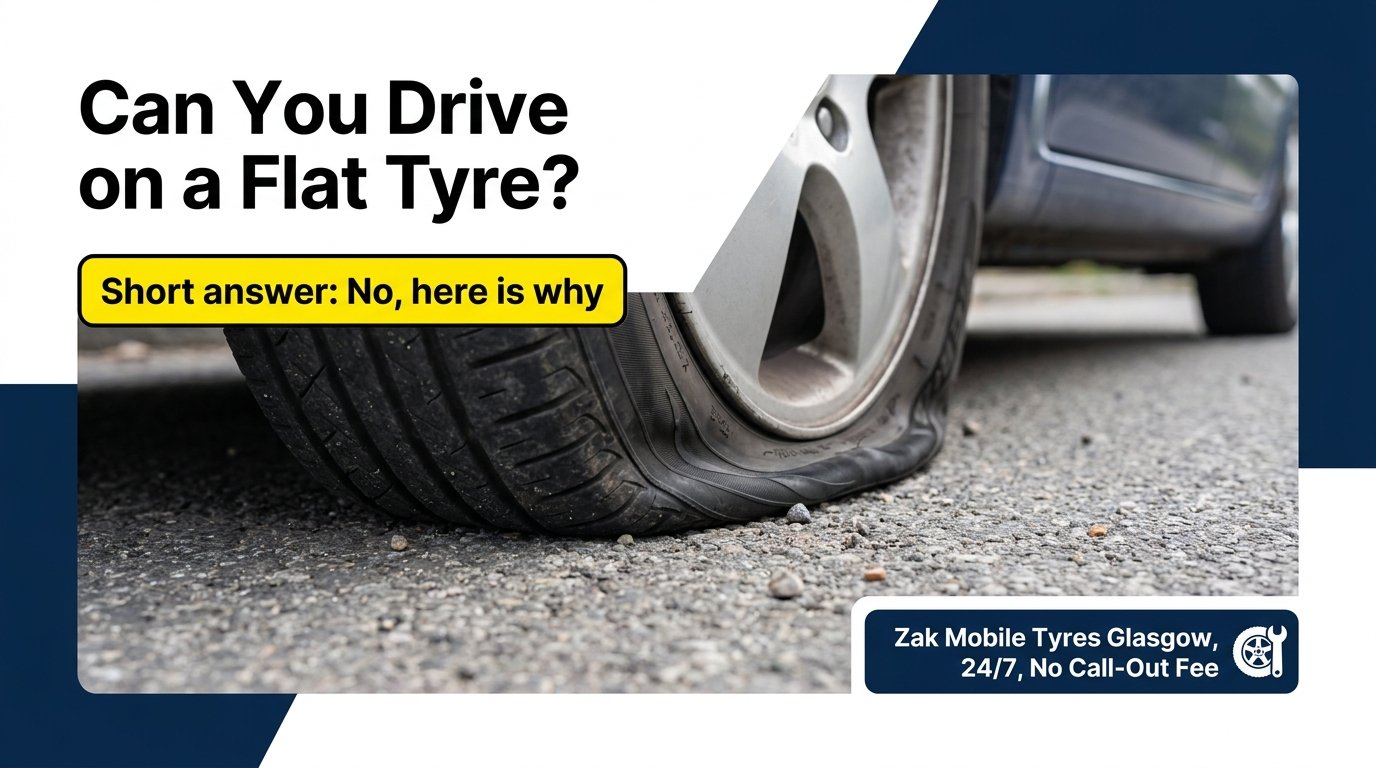
Can you drive on a flat tyre? The honest answer is no. You should not drive on a fully flat tyre, not even a short distance to the nearest garage. Doing so can destroy the tyre, damage the wheel rim within a few hundred metres, and leave you with a far bigger bill than the puncture itself.
There is one narrow exception. The Highway Code allows you to move a very short distance at walking pace to reach a safe place, away from traffic, so you can assess the damage. That is not the same as driving on to a garage.
If you have run-flat tyres, you have more room, typically up to around 50 miles at up to 50mph, but they still need replacing afterwards. If you have no spare, which is the case with most modern cars, you will need a mobile fitter or recovery to come to you.
Disclaimer: Zak Mobile Tyres Glasgow is a mobile tyre fitting and repair service, not a garage or recovery operator. Prices shown are starting prices and vary by tyre size, brand, and specification. Tyre condition should always be inspected by a qualified technician before repair or replacement. This guide is for information only and does not replace on-site inspection.
The Short Answer, and Why
A tyre is designed to carry the weight of your car on air pressure, not on rubber. When that pressure is gone, the tyre can no longer do its job, and the forces that were spread across the whole structure are dumped onto a small area of soft, unsupported rubber and the metal rim.
That is why the damage happens so fast. Industry guidance is consistent that driving even one mile on a fully flat tyre is usually enough to destroy it, and rim damage can begin within a few hundred metres. What started as a repairable puncture becomes a scrapped tyre and, often, a damaged alloy.
There is also the safety side. A flat tyre pulls the car to one side, lengthens your braking distance and makes the steering vague and unpredictable. At any speed above a crawl, that is genuinely dangerous, both for you and for other road users.
So the rule is simple. If the tyre is fully flat, stop as soon as it is safe and do not try to drive on.
Is It Illegal to Drive on a Flat Tyre?
Beyond the damage, there is a legal dimension. Under the Road Vehicles (Construction and Use) Regulations 1986, your tyres must be inflated to make them fit for the purpose for which the vehicle is being used, and must be free from certain defects. A fully flat or seriously deflated tyre falls foul of that, and a tyre in a dangerous condition is an offence that carries a fine and penalty points.
The Highway Code is also clear on what to do in a blowout: keep a firm grip on the wheel, let the car slow gradually, and pull over as soon as it is safe. It permits moving to a place of safety to view the damage, but it does not sanction driving on to the nearest garage on a flat.
In plain terms: nudging the car a few metres off a live carriageway to safety is reasonable and legal. Setting off to drive two miles to a tyre place on a flat is neither.
How Far Can You Actually Drive on a Flat?
The figure people want is a distance, so here is the honest version.
On a standard tyre that is fully flat: effectively zero. Move only far enough, at walking pace, to reach safety. Every additional metre risks the rim.
On a slow puncture that is still holding some pressure: you may be able to travel a short distance at low speed to reach a safe place or somewhere a fitter can reach you, but check the pressure first and stop if it keeps dropping. A slow puncture is not the same as a flat.
On a run-flat tyre: manufacturers vary, but the widely quoted limit is up to around 50 miles at up to 50mph after a loss of pressure. That is a get-you-to-safety allowance, not a licence to carry on. A run-flat that has been driven on while deflated almost always cannot be repaired and needs replacing with a new run-flat.
The safe takeaway is that distance is not really the point. Stopping early is almost always cheaper and safer than trying to reach a garage.
What to Do the Moment You Get a Flat
Whether it is a slow deflation you have noticed or a sudden blowout, the sequence is the same.
- Keep control. Grip the wheel firmly, ease off the accelerator, and let the car slow gradually rather than braking hard.
- Get to a safe place. Pull as far off the carriageway as you can, onto a driveway, lay-by, hard shoulder or verge.
- Hazards on. Switch on your hazard lights so other traffic sees you early.
- Get clear if you are roadside. On a motorway or fast road, get everyone out on the side away from traffic and wait behind the barrier. Never attempt a change in a live lane.
- Assess, do not drive on. Look at the tyre. If it is flat, this is the point you call for help rather than drive.
If your flat has happened on the motorway, our 24/7 emergency tyre service covers the M8, M74 and M77 and dispatches immediately, day or night.
What If You Have No Spare Wheel?
Here is the situation most drivers now find themselves in. To save weight and space, the majority of new cars come with no spare wheel at all, only a tyre sealant kit or a set of run-flats.
A sealant kit can sometimes get you moving after a small tread puncture, but it is useless against a sidewall tear, a large hole or a blowout, which are exactly the failures that leave you stranded. If your car has no spare and the tyre cannot be sealed, you are not driving anywhere safely.
This is precisely where a mobile tyre service earns its place. Rather than waiting for recovery to tow you to a garage, we come to you with a replacement tyre and fit it on the spot, at your home, workplace or the roadside. If you are unsure whether your car even has a spare, check the boot floor now, before you ever need it, so a flat is never a nasty surprise.
Flat Tyre or Repairable Puncture?
Not every deflated tyre is a write-off, and this is worth understanding before you assume the worst.
If the tyre went down slowly and the cause is a nail or screw sitting in the central tread, there is a good chance it can be repaired safely and legally, for a fraction of the cost of a replacement. If the tyre was driven on while flat, or the damage is to the sidewall or shoulder, it cannot be repaired and must be replaced.
The only way to know is a proper inspection. Our technicians check the damage on-site and tell you honestly whether a puncture repair or a replacement is the right call. You will never be sold a tyre you did not need. If a repair is possible, that is what we will do.
Get an upfront price with no call-out fee under 2km and if the tyre can be saved, you keep the cost down.
Why Driving On Costs You More
It is tempting to think limping to a garage saves money. It usually does the opposite. Drive on a flat and you turn a repairable puncture into a scrapped tyre, and you can bend or crack the alloy wheel, which is often dearer to put right than the tyre itself. A single call to a mobile fitter who comes to you is almost always cheaper than the repair bill that follows a few miles on a flat.
Practical Takeaways
Do not drive on a fully flat tyre. Not even to the nearest garage. Move only far enough, at walking pace, to reach safety.
A slow puncture is different. If the tyre still holds pressure, a short, low-speed trip to safety may be possible, but check the pressure and stop if it keeps falling.
Run-flats buy you time, not a pass. Up to around 50 miles at 50mph to reach help, then replacement.
Know your car. Check now whether you have a spare, a sealant kit or run-flats, so a flat never catches you out.
Call for help, do not drive on, if you see any of these
- The tyre is fully flat or sitting on the rim
- A visible sidewall bulge, split or tear
- A blowout at speed
- Rapid deflation that a sealant kit will not hold
- You have no spare and cannot safely change the wheel
If any of these apply, you need a tyre brought to you rather than a risky drive to a garage. Our roadside tyre assistance covers Glasgow and Central Scotland, day or night, with no call-out fee under 2km.
Frequently Asked Questions
Can you drive on a flat tyre to the nearest garage?
No. You should not drive on a fully flat tyre, even a short distance to a garage. Driving even a mile can destroy the tyre and damage the wheel rim within a few hundred metres. Move only at walking pace to reach safety, then call a mobile fitter or recovery.
How far can you drive on a flat tyre?
Effectively zero on a standard flat tyre. Rim damage can begin within a few hundred metres. Run-flat tyres are the exception, allowing up to around 50 miles at up to 50mph to reach safety, after which they usually need replacing rather than repairing.
Is it illegal to drive on a flat tyre in the UK?
Driving on a dangerously deflated tyre can be an offence under the Road Vehicles (Construction and Use) Regulations 1986, carrying a fine and penalty points. The Highway Code allows moving a short distance to a place of safety, but not driving on to a garage on a flat.
What should I do if I have a flat and no spare wheel?
Most modern cars carry only a sealant kit, which cannot fix sidewall or large punctures. If you have no usable spare, do not drive on the flat. Call a mobile tyre service to bring and fit a replacement at your location, or arrange recovery. Call or WhatsApp 07553 352305.
Can a flat tyre be repaired or does it need replacing?
It depends on the cause. A nail in the central tread on a tyre that was not driven flat can often be repaired safely. A tyre driven on while flat, or with sidewall damage, must be replaced. Only an on-site inspection can confirm which applies to your tyre.
Conclusion
So, can you drive on a flat tyre? No. The safe, legal and cheapest answer is to stop as soon as it is safe, move only far enough at walking pace to get clear of traffic, and call for help rather than drive on. A few miles on a flat turns a simple puncture into a scrapped tyre and a damaged wheel.
If you are stuck with a flat anywhere across Glasgow and Central Scotland, we come to you and fit a replacement on the spot, day or night, with no call-out fee under 2km across Glasgow. Save our number now, because the best time to have a mobile tyre fitter is before you are standing next to a flat.