
Executive Summary
A punctured tyre can be repaired, but only if the damage falls within strict safety rules. In the UK, tyre repairs are governed by a British Standard, BS AU 159, and a repair is only legal and safe when the puncture is in the central tread area, is no larger than a set limit, and the tyre has not been damaged by being driven on while flat. Punctures in the sidewall or shoulder cannot be repaired, and a tyre that has run flat usually cannot either.
In practice this means a simple nail in the middle of the tread is very often repairable, and far cheaper than a new tyre, while a gash in the sidewall or a tyre that has been driven on deflated will need replacing. The only way to know for sure is a proper inspection, because damage on the inside of the tyre is not visible from the outside.
This guide explains what the rules actually say, what can and cannot be repaired, and why a quick roadside plug is not the same as a proper repair.
Disclaimer: This is general guidance. Whether a specific tyre can be safely and legally repaired must be decided by a qualified technician inspecting the actual tyre, in line with the current British Standard. When in doubt, a tyre should be replaced rather than repaired.
The Rule in Plain English: BS AU 159
Tyre repairs in the UK are carried out to a British Standard called BS AU 159. You do not need to memorise the code, but the principles behind it decide whether your tyre can be saved.
The standard sets out a minor repair area, which is the central portion of the tread, and says repairs may only be made within it. It sets a maximum size for the puncture that can be repaired. It requires the tyre to be removed from the wheel and inspected inside, not just plugged from the outside, so the technician can check for hidden damage. And it rules out repairing a tyre that shows signs of having been run underinflated or flat, because that causes internal structural damage.
The reason for all this is simple. A tyre is a safety-critical part holding your car to the road at speed. A repair in the wrong place, or on a tyre already weakened inside, can fail suddenly. The standard exists to make sure a repaired tyre is genuinely as safe as it needs to be.
What Can Be Repaired
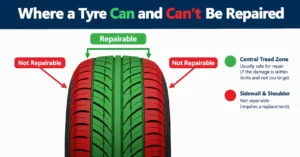
The good news is that the most common puncture of all is usually repairable.
A nail or screw in the central tread is the classic case. If it sits within the central repairable zone, is within the size limit, and the tyre has not been driven on flat, it can almost always be repaired properly and safely. This is by far the most frequent puncture we see, and it is why it is always worth having a tyre inspected before assuming you need a new one.
A small, clean puncture that the driver noticed quickly, topped up, and did not drive on while flat is a strong candidate for repair. Catching it early is what keeps it repairable.
When a tyre qualifies, a proper repair costs a fraction of a replacement. That is the whole reason our mobile puncture repair exists: we inspect first and save the tyre wherever the rules allow, rather than defaulting to selling you a new one.
What Cannot Be Repaired
Some damage is not repairable under any circumstances, and a trustworthy fitter will tell you so plainly.
Sidewall damage. The sidewall flexes constantly as you drive and cannot hold a repair. Any puncture, cut, or bulge in the sidewall means the tyre must be replaced. There is no safe exception.
Shoulder punctures. The shoulder, the area between the tread and the sidewall, falls outside the repairable zone. Punctures here cannot be repaired.
Anything driven on while flat. This is the big one that catches people out. If you drove on the tyre after it lost pressure, even a short distance, the sidewall may have been crushed and damaged internally, invisible from the outside. Such a tyre cannot be safely repaired. Our guide on whether you can drive on a flat tyre explains why the damage happens so fast.
Large punctures, beyond the size limit in the standard, and multiple punctures close together, which weaken the structure too much.
Most run-flat tyres that have actually run flat. Once a run-flat has carried the car deflated, it has usually done its one job and needs replacing. Our run-flat tyre fitting page covers this in detail.
In all of these cases the safe route is a tyre replacement, which we can carry out on the spot.
Why a Roadside Plug Is Not a Proper Repair
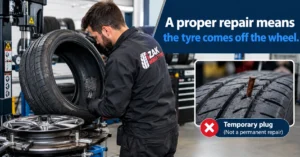
You may have seen tyre plug kits, or been offered a quick external plug. It is important to understand the difference.
A plug or a sealant pushed in from the outside without removing the tyre is a temporary, get-you-home measure at best. It does not allow the inside of the tyre to be inspected, so hidden damage goes unseen, and it does not meet the British Standard for a permanent repair. Relying on one as a lasting fix is a genuine safety risk.
A proper repair, by contrast, means the tyre is removed from the wheel, inspected inside and out, and repaired from the inside using a combined patch and plug that seals the hole and the inner liner together. That is what makes it safe and legal, and it is what BS AU 159 requires. When we carry out a repair, it is done properly, not plugged and forgotten.
How to Give Your Tyre the Best Chance of Being Repairable
A few simple things make the difference between a cheap repair and a new tyre.
Do not drive on it flat. The moment a tyre is flat, stop as safely as you can. Every hundred metres driven flat raises the chance the tyre is written off. This single habit saves more tyres than anything else.
Catch slow punctures early. If a tyre needs topping up regularly, get it looked at before it goes fully flat, while it is still in good condition.
Send a photo before you assume the worst. If you can see the object and it is in the central tread, there is a good chance of a repair. A quick photo on WhatsApp lets us give you an honest steer before we even arrive.
If it turns out the tyre cannot be saved, you have lost nothing by checking, because we do not charge for a tyre we did not need to touch.
Frequently Asked Questions
Can a punctured tyre always be repaired? No. A puncture can only be repaired if it is in the central tread area, within a size limit, and the tyre has not been driven on while flat, in line with the British Standard BS AU 159. Sidewall and shoulder damage, large punctures, and tyres run flat cannot be safely repaired and must be replaced.
Can a nail in my tyre be repaired? Usually yes, if the nail is in the central tread, the hole is within the size limit, and you did not drive far on it flat. A nail in the middle of the tread is the most common repairable puncture. It should be inspected properly, with the tyre removed from the wheel, rather than just plugged from outside.
Why can’t a sidewall puncture be repaired? The sidewall flexes constantly as the tyre carries the car and turns, and it cannot hold a repair reliably. A repair there could fail suddenly at speed. For that reason, any puncture, cut or bulge in the sidewall means the tyre must be replaced, with no safe exception.
Is a tyre plug a permanent repair? No. An external plug or sealant pushed in without removing the tyre is a temporary, get-you-home measure at best. It does not allow the inside of the tyre to be inspected and does not meet the British Standard for a permanent repair. A proper repair means removing the tyre and repairing it from the inside.
Can a run-flat tyre be repaired after a puncture? Usually not. A run-flat that has been driven on while deflated has typically suffered internal damage that cannot be seen from outside, which makes a repair unsafe. Most manufacturers and fitters advise replacing a run-flat that has run flat rather than repairing it.
Conclusion
So, can a punctured tyre be repaired? Often yes, when the damage is a puncture in the central tread, within the size limit, on a tyre that was not driven flat, all as set out in BS AU 159. But sidewall and shoulder damage, large or multiple punctures, and tyres run flat cannot be safely repaired and need replacing. The only way to know for certain is a proper inspection with the tyre off the wheel.
Before you pay for a new tyre, let us check. Our mobile puncture repair inspects on site and saves the tyre wherever the rules safely allow, at your home or the roadside across Glasgow, with no call-out fee.