
Executive Summary
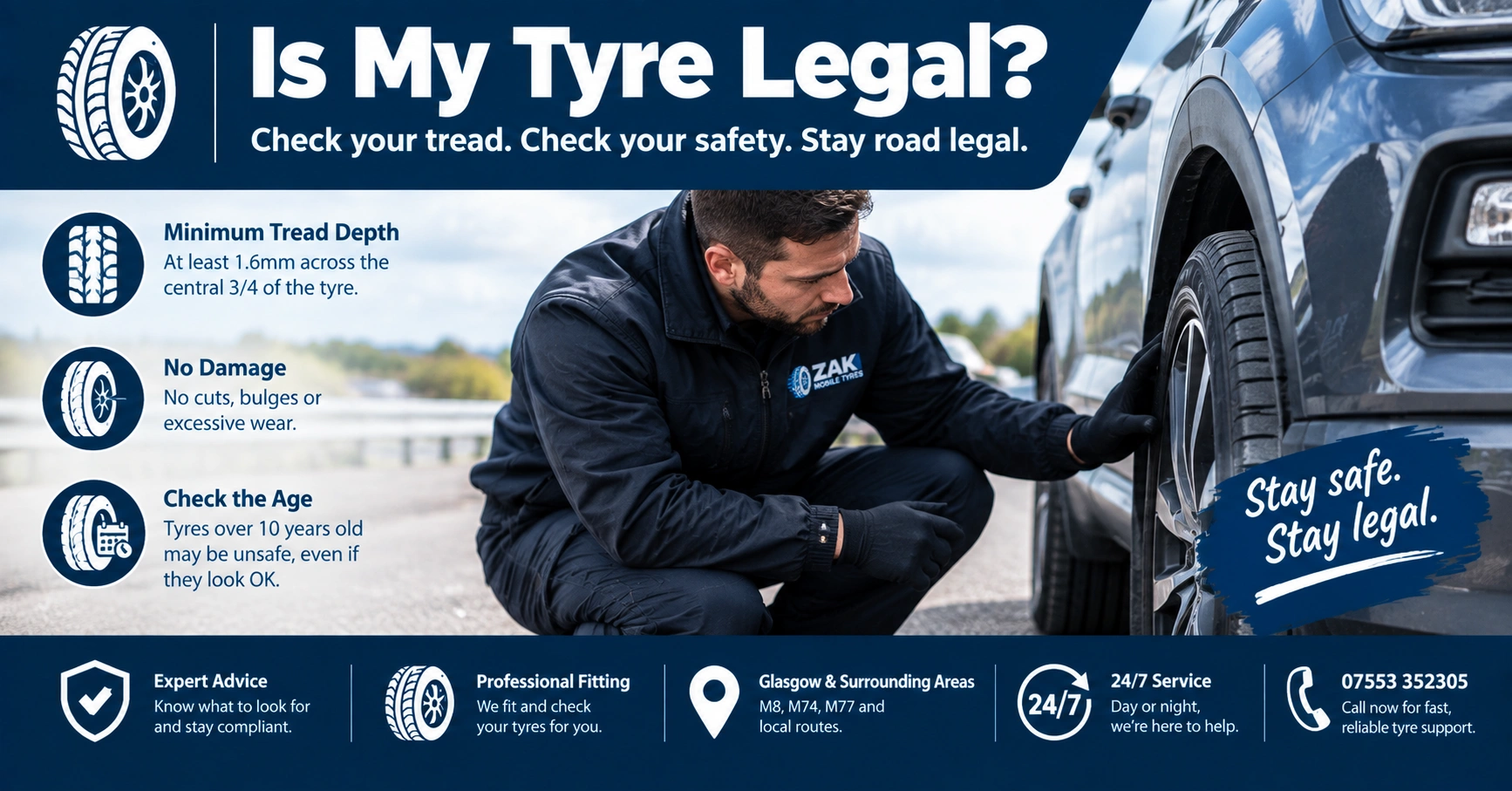
A tyre is legal in the UK when it has at least 1.6mm of tread across the central three-quarters and around the full circumference, is free of dangerous cuts, bulges and exposed cord, is correctly inflated, and meets the load and speed rating your vehicle requires. If any one of those fails, the tyre is illegal, and the penalties are serious: up to £2,500 and three penalty points per tyre, so a full set could in theory cost twelve points and your licence.
Most drivers never check until an MOT, but tyres wear continuously, and a tyre that was legal a few months ago may not be now. A two-minute check can save you a fine, points, and far worse in an emergency stop.
This guide is a plain checklist you can run through yourself, covering exactly what makes a tyre legal or illegal in the UK.
Disclaimer: This is general guidance. If you are unsure whether a tyre is legal or safe, have it inspected by a qualified technician. When in doubt, replace rather than risk it.
The Five-Point Legal Checklist
Run through these five. If all pass, the tyre is legal. If any one fails, it is not.
1. Tread depth: at least 1.6mm
The legal minimum tread depth in the UK is 1.6mm, across the central three-quarters of the tyre and around its entire circumference. Below that, the tyre is illegal. The quick test is the 20p test: insert a 20p coin into the main grooves, and if the outer band of the coin is visible, your tread may be too low and needs checking properly. Our guide on tyre tread depth explains this in full.
2. No dangerous damage
The tyre must be free of cuts, tears, lumps or bulges that could cause sudden failure. A bulge in the sidewall is an immediate fail and a serious danger, as it signals internal damage. Any cut deep enough to reach the cords, or any exposed cord or ply, makes the tyre illegal.
3. Correct inflation
The tyre must be inflated to the pressure your vehicle specifies. A significantly under or over inflated tyre is both unsafe and, in the case of severe underinflation causing damage, a route to an illegal tyre. Check against the figures on your door pillar or handbook.
4. Correct type and matching
The tyre must be of a suitable type for the vehicle and, in general, tyres of different structure (such as mixing radial and cross-ply) must not be fitted on the same axle. It must also be free of any repair that does not meet the proper standard.
5. Correct load and speed rating
The tyre must meet or exceed the load index and speed rating specified for your vehicle. Fitting a tyre rated below your car’s requirement is unsafe and non-compliant. Our guide on tyre numbers explains how to read these.
The Penalties, and Why They Are So Steep
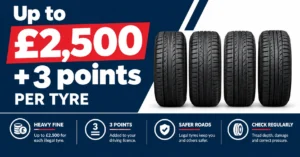
The law treats illegal tyres seriously, and the numbers explain why it is worth checking.
Driving with an illegal tyre carries a penalty of up to £2,500 and three penalty points, per tyre. That “per tyre” detail is what catches people out. Two illegal tyres is six points; a full set of four, in theory, is twelve points and a possible driving ban on top of a very large fine.
Beyond the legal penalty, there is the insurance angle: driving on illegal tyres could affect a claim if you are involved in an incident. And beyond all of that is the real reason the law exists, which is that your tyres are the only thing connecting your car to the road. A worn or damaged tyre lengthens your stopping distance and can fail without warning. The fine is the least of the risks.
How to Run the Check Yourself
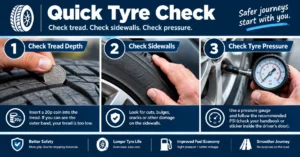
The whole check takes a couple of minutes per tyre, in your driveway.
Look and feel around the whole tyre. Turn the wheel to full lock to see the front tyres clearly. Run your eye and hand around the tread and both sidewalls, feeling for bulges, cuts or embedded objects. Look for uneven wear, which can signal alignment or pressure problems.
Do the 20p test in several places. Check the tread depth at the inner, middle and outer sections and at a few points around the tyre, because tyres often wear unevenly. If the coin’s border shows anywhere in the main grooves, get it measured properly.
Check the pressures cold against your vehicle’s figures, and top up if needed.
Note anything odd. A tyre losing pressure regularly, wearing on one edge, or showing cracks in the rubber all warrant a proper look. If you spot damage you are unsure about, a quick photo sent to a fitter can settle it. If a tyre fails any point, do not keep driving on it, arrange a car tyre replacement, or if the damage looks like a repairable tread puncture, a mobile puncture repair check.
Frequently Asked Questions
What is the legal tyre tread depth in the UK? The legal minimum is 1.6mm, measured across the central three-quarters of the tyre and around its entire circumference. Below that, the tyre is illegal. Many safety experts recommend replacing at around 3mm, since wet grip falls off well before the legal limit.
What makes a tyre illegal? A tyre is illegal if it has less than 1.6mm tread, has dangerous cuts, bulges or exposed cord, is unsuitable or wrongly matched for the vehicle, has an improper repair, or does not meet the vehicle’s load and speed rating. Any one of these makes the tyre illegal to use on the road.
What is the penalty for an illegal tyre? Up to £2,500 and three penalty points per tyre. Because it is per tyre, multiple illegal tyres multiply the penalty, so a full set could mean twelve points and a possible ban, as well as affecting any insurance claim. The penalties are steep because tyres are safety-critical.
How do I check if my tyre is legal myself? Run the 20p test for tread depth in several places, inspect the whole tyre by eye and hand for cuts, bulges or exposed cord, check the pressures against your vehicle’s figures, and confirm the load and speed rating. If all pass the tyre is legal; if any fails, it is not and should be replaced.
Is a bulge in my tyre illegal? Yes. A bulge in the sidewall indicates internal structural damage and makes the tyre both illegal and dangerous, as it can fail suddenly. It cannot be repaired and the tyre must be replaced. Do not drive on a tyre with a visible bulge.
Conclusion
Is your tyre legal? Run the five-point check: at least 1.6mm tread, no dangerous damage, correct inflation, suitable type and matching, and the right load and speed rating. Fail any one and the tyre is illegal, with penalties of up to £2,500 and three points per tyre, and far greater safety risks than that.
The check takes minutes and could save you a great deal. If a tyre fails, or you are not sure, we can help. Our car tyre replacement brings a legal, correctly-rated tyre to your door across Glasgow, with no call-out fee.