
Executive Summary
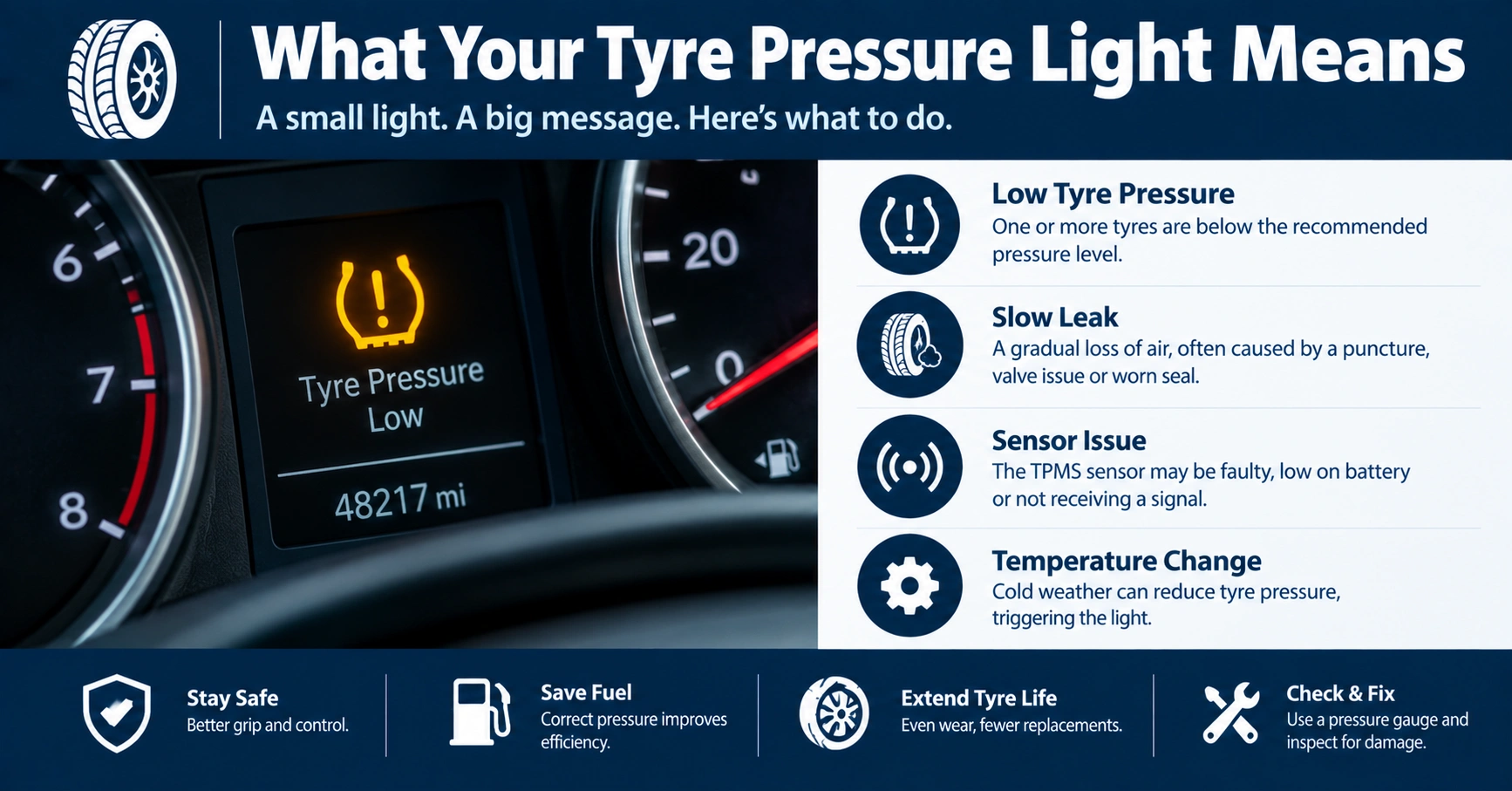
The tyre pressure warning light is your car’s TPMS, or Tyre Pressure Monitoring System, telling you that one or more tyres has lost pressure, or that the system itself has a fault. It usually looks like a horseshoe or cross-section of a tyre with an exclamation mark inside. When it comes on steadily, check and adjust your pressures. When it flashes then stays on, the system itself may have a fault, often a failed sensor.
TPMS matters because underinflated tyres are dangerous: they grip less, wear faster, use more fuel and can overheat and fail. Since 2014 it has been mandatory on new cars in the UK and EU, and a TPMS that is fitted but not working is an MOT failure.
This guide explains how TPMS works, why the light comes on, what to do about it, and why it needs attention whenever a tyre is fitted or repaired.
Disclaimer: Warning light behaviour varies between vehicles. Always check your handbook for what your specific car’s light indicates and the correct pressures for your vehicle.
What TPMS Is and How It Works
TPMS stands for Tyre Pressure Monitoring System. Its job is simple: to warn you when a tyre loses pressure, so you are not driving on a dangerously soft tyre without realising, which is easy to do, since a tyre can be well down on pressure before it looks visibly flat.
There are two types. Direct TPMS uses a sensor inside each wheel that measures the actual pressure and sends it to the car. This is the more accurate type and the one that can sometimes show individual tyre pressures on the dashboard. Indirect TPMS does not use pressure sensors; instead it works through the car’s ABS wheel-speed sensors, detecting that an underinflated tyre rotates at a slightly different rate. It is simpler but less precise, and it needs resetting after adjusting pressures.
Knowing which type your car has matters, because it changes what happens when a tyre is fitted. Direct systems have physical sensors that can be damaged or need reactivating; indirect systems just need a reset. Either way, TPMS needs handling correctly during any tyre work, which is part of every mobile tyre fitting we do.
Why the Light Comes On
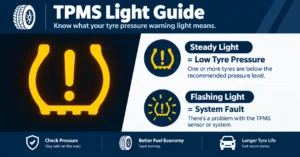
The warning light comes on for a few distinct reasons, and how it behaves tells you which.
A genuine loss of pressure. The most common reason. A slow puncture, a valve leak, or simply the natural pressure drop over time or in cold weather has taken a tyre below the threshold. The light comes on steadily. This is the one to act on promptly, since it may signal a puncture.
Cold weather. Air contracts as it cools, so a drop in temperature can lower your pressures enough to trigger the light, especially overnight in a Scottish winter. Topping up to the correct pressure usually clears it. This is why the light often appears on the first cold morning of the season.
A system or sensor fault. If the light flashes for a period when you start up and then stays on, that typically indicates a fault in the system itself rather than low pressure, often a failed sensor battery on a direct TPMS. Sensors have a limited life and eventually need replacing.
After tyre work, if not reset. If the system was not correctly reset or the sensors not reactivated after fitting, the light can stay on even with correct pressures. This is avoidable with proper fitting.
What to Do When the Light Appears
Here is the practical sequence.
Check your pressures. Use a reliable gauge, at a garage forecourt or your own, and compare against the correct figures for your car, found on the door pillar sticker or in the handbook. Remember to check when the tyres are cold for an accurate reading.
Top up any that are low, then see whether the light clears, which may take a short drive on some systems. If it clears, it was simply low pressure, though it is worth noting which tyre so you can watch for a slow puncture.
If one tyre is repeatedly low, suspect a puncture. A tyre that keeps triggering the light after topping up likely has a slow leak, a nail, or a valve fault. That needs inspecting, and if repairable we can carry out a mobile puncture repair on the spot.
If the light indicates a system fault, flashing then staying on, the sensors or system need attention rather than air. A failed sensor typically needs replacing.
Do not simply ignore it. Whatever the cause, the light is flagging something that affects safety, wear and fuel economy. Driving on for weeks with it on is exactly how a slow puncture becomes a roadside emergency.
TPMS, Tyre Fitting and the MOT
Two things every driver should know about TPMS beyond the warning light.
It is an MOT item. Since TPMS became mandatory on new cars from 2014, a system that is fitted but not working is an MOT failure. So a warning light left on is not just a nuisance, it can fail your test. If your light is on, it is worth resolving before the MOT rather than being caught out.
It needs handling during tyre work. When a tyre is changed on a car with direct TPMS, the sensor inside the wheel has to be handled carefully, and after fitting the system usually needs resetting or the sensor reactivating so the dashboard reads correctly. Sensors can also be damaged by careless fitting or simply reach the end of their battery life and need replacing at the same time. A fitter who understands TPMS checks and resets it as a matter of course, which is exactly what we do on every relevant job, and it is especially important on run-flat cars, covered in our run-flat tyre fitting.
This is one of those areas where proper fitting shows: a tyre changed without attending to the TPMS leaves you with a warning light and a potential MOT problem, when it should have been resolved on the spot.
Frequently Asked Questions
What does the tyre pressure warning light mean? It means your TPMS has detected that one or more tyres has lost pressure, or that the system itself has a fault. A steady light usually means low pressure; a light that flashes on startup then stays on usually means a system or sensor fault. Either way it should be checked rather than ignored.
Why does my tyre pressure light keep coming on in cold weather? Air contracts as it cools, so a drop in temperature lowers your tyre pressures, which can trigger the light, especially on cold mornings. Topping the tyres up to the correct pressure usually clears it. It is common on the first cold days of a Scottish autumn or winter.
Is a TPMS warning light an MOT failure? Yes. Since TPMS became mandatory on new cars from 2014, a system that is fitted but not working is an MOT failure. So a warning light left on can fail your test, which is why it is worth resolving beforehand rather than ignoring it.
The light is on but my pressures look fine. What’s wrong? If pressures are correct but the light stays on, the system itself likely has a fault, commonly a failed sensor battery on a direct TPMS, or the system was not reset after tyre work. Sensors have a limited life and eventually need replacing. It needs diagnosing rather than more air.
Do I need to reset TPMS after fitting a new tyre? Usually yes. Indirect systems need a reset after fitting or adjusting pressures, and direct systems need the sensors handled and reactivated so the car reads them correctly. A fitter who understands TPMS does this as part of the job, so you drive away with the light off and the system working.
Conclusion
Your tyre pressure warning light is the TPMS doing its job: alerting you to a tyre that has lost pressure, or to a fault in the system itself. A steady light usually means low pressure, often a slow puncture or cold weather; a flashing-then-steady light usually means a sensor or system fault. It is also an MOT item, so it should never simply be left on.
If the light keeps coming on for one tyre, it likely has a slow puncture worth inspecting. Our mobile puncture repair diagnoses the real cause on site and, on every fitting, we check and reset your TPMS so you drive away with the light off, across Glasgow, with no call-out fee.