
Executive Summary
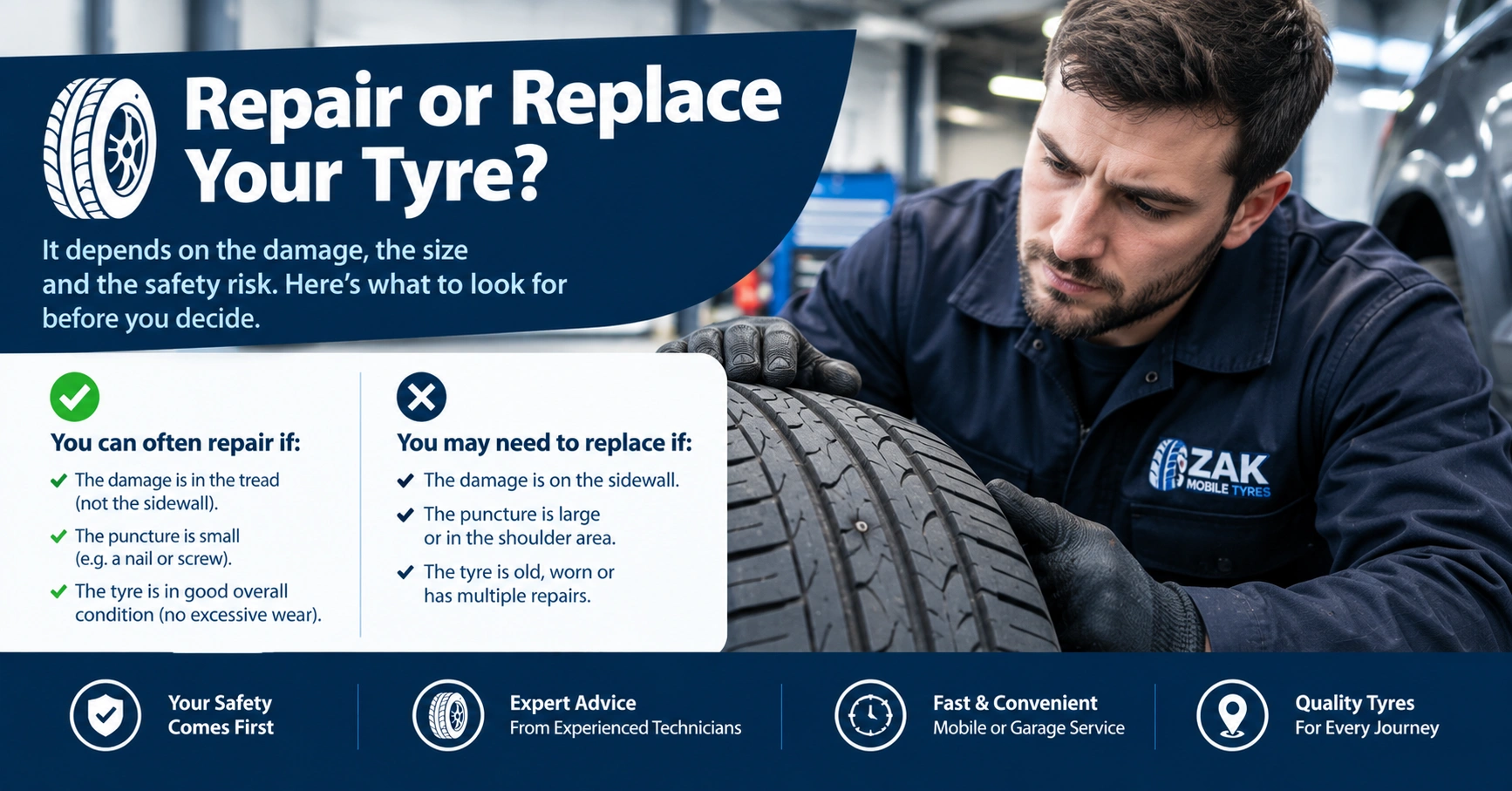
Whether to repair or replace a tyre comes down to three things: where the damage is, how worn the tyre already is, and whether it has been driven on while flat. A small puncture in the central tread, on a tyre with decent tread left that was not driven flat, can usually be repaired, and repairing is far cheaper. Damage to the sidewall or shoulder, a tyre already low on tread, or one driven on deflated all mean replacement.
The decision is genuinely important because it is both a safety and a money question. Replacing a tyre that could have been safely repaired wastes money, while repairing one that should be replaced is dangerous. A trustworthy fitter inspects first and gives you the honest answer, rather than defaulting to the more expensive option.
This guide gives you a clear framework so you understand the decision before anyone looks at your tyre.
Disclaimer: The final decision on whether a specific tyre is safe to repair must be made by a qualified technician inspecting the actual tyre. When there is genuine doubt, the safe choice is always replacement.
The Three Questions That Decide It
Almost every repair-or-replace decision comes down to three checks, in order.
1. Where is the damage?
This is the first and biggest question. Damage in the central tread can often be repaired. Damage in the sidewall or shoulder cannot ever be repaired, because those areas flex too much to hold a safe repair. So a nail in the middle of the tread is a promising sign, while a cut or bulge in the sidewall is an immediate replacement. Our guide on whether a punctured tyre can be repaired covers the exact repairable zone.
2. How worn is the tyre already?
Even if the damage is repairable, ask whether the tyre is worth repairing. If it is already close to the 1.6mm legal tread limit, or would need replacing soon anyway, spending money on a repair is a false economy. If it has plenty of tread left, a repair keeps a good tyre in service. Our guide on tyre tread depth explains how to check.
3. Was it driven on while flat?
Even a repairable puncture in a tyre with good tread becomes a replacement if the tyre was driven on while flat, because the sidewall may be damaged internally where you cannot see it. This is the one that catches people out, and it is why stopping promptly matters so much.
If the answer to all three is favourable- damage in the tread, decent tread left, not driven flat, you have a repair. If any one fails, it is a replacement.
When to Repair
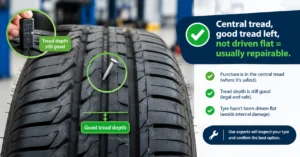
Repair is the right call, and the cheaper one, when the tyre genuinely qualifies.
A nail or screw in the central tread, caught before you drove far on it flat, on a tyre with plenty of tread, is the textbook repairable case. It is also the most common puncture there is. A proper repair, with the tyre removed and inspected inside, restores it to safe use at a fraction of the cost of a new tyre.
The value here is real. There is no sense buying a new tyre when a sound one can be safely saved, and a good fitter will always check for a repair first. That is exactly how our mobile puncture repair works: inspect, and repair where the rules allow, rather than replacing by default.
When to Replace
Replacement is the safe and necessary choice in a clear set of cases, and no repair should be attempted in any of them.
Sidewall or shoulder damage, including any bulge, cut or puncture outside the central tread. Tread already near the legal limit, where the tyre is due for replacement regardless. A tyre driven on while flat, with likely hidden internal damage. Large or multiple punctures beyond what a repair can safely restore. And most run-flats that have run flat, which have usually done their job once and need replacing, as our run-flat tyre fitting page explains.
Cracked or perished rubber from age, even without a puncture, is also a replacement, because old rubber loses grip and can fail. In all these cases a car tyre replacement is the right answer, and we can fit one on the spot.
The Money Side, Honestly
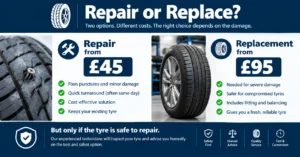
It is worth being straight about the economics, because it cuts both ways.
A repair is much cheaper than a replacement, so where a tyre genuinely qualifies, repairing saves you real money. That is a good reason to always have a tyre inspected before assuming the worst, and to be wary of anyone who reaches for a new tyre without checking whether a repair is possible.
But the reverse is also true. Repairing a tyre that is already worn out, or trying to save one that should be replaced, is a false economy at best and unsafe at worst. Spending forty-odd pounds to repair a tyre that needs replacing in a month is money wasted, and repairing something that is not safe to repair is a risk no saving justifies.
The honest position is the one we work to: inspect first, repair where it is genuinely safe and worthwhile, replace where it is not, and never charge for a tyre that did not need touching. Whether repair or replace works out cheaper depends entirely on the tyre, which is why the inspection comes first.
Frequently Asked Questions
Should I repair or replace a punctured tyre? Repair if the damage is a small puncture in the central tread, the tyre still has good tread, and it was not driven on while flat. Replace if the damage is in the sidewall or shoulder, the tread is already low, the tyre was run flat, or there are large or multiple punctures. When in doubt, replacement is the safe choice.
Is it cheaper to repair or replace a tyre? A repair is much cheaper than a replacement, so where a tyre genuinely qualifies for repair, repairing saves money. But repairing a tyre that is already worn out or unsafe is a false economy. The right choice depends on the tyre’s condition, which is why a proper inspection comes first.
Can I repair a tyre with low tread? You can, but it is usually not worth it. If the tyre is already near the 1.6mm legal limit and due for replacement soon, spending on a repair is a false economy. A repair makes sense on a tyre with plenty of tread left, not one that needs replacing anyway.
How do I know if my tyre can be repaired? The damage must be a puncture in the central tread, within a size limit, on a tyre not driven flat. Sidewall and shoulder damage cannot be repaired. The only way to be certain is a proper inspection with the tyre removed from the wheel, since internal damage is not visible from outside.
Is it safe to keep driving on a repaired tyre? Yes, a properly repaired tyre, done to the British Standard with the tyre removed and inspected and repaired from the inside, is safe for normal use. A temporary external plug is not the same thing and should only be treated as a get-you-home measure until a proper repair or replacement.
Conclusion
Should you repair or replace a tyre? Repair a small puncture in the central tread, on a tyre with good tread that was not driven flat. Replace for sidewall or shoulder damage, low tread, a tyre run flat, or large and multiple punctures. The decision is a safety question first and a money question second, and it always starts with a proper inspection.
Before you assume you need a new tyre, let us check. Our mobile puncture repair inspects on site and gives you the honest answer, repairing where it is safe and worthwhile across Glasgow, with no call-out fee.