
Executive Summary
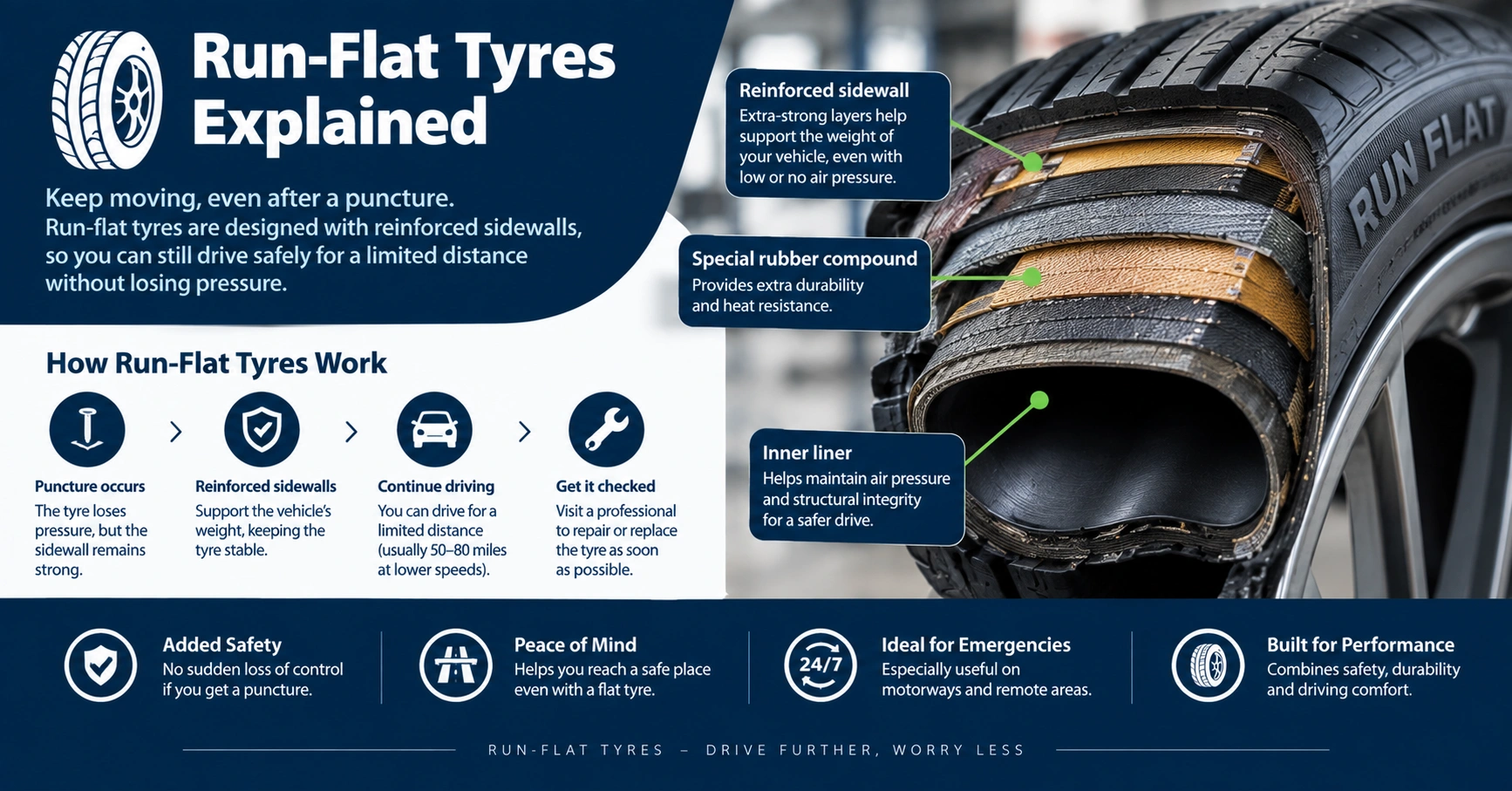
Run-flat tyres are designed to keep you driving for a limited distance after a puncture, so you are not stranded and do not have to change a wheel at the roadside. They do this with reinforced sidewalls stiff enough to carry the car’s weight briefly with no air in them. As a rough guide, most run-flats let you drive up to around 50 miles at a reduced speed of about 50 miles an hour after losing pressure, though you must check your specific tyre, because limits vary.
The trade-offs are real. Run-flats cost more to buy, most cannot be repaired once they have run flat, they can give a slightly firmer ride, and cars fitted with them usually carry no spare wheel at all. They are common on BMW, Mini, many Mercedes and some other makes.
This guide explains how they work, how far and fast you can really drive on one, whether they can be repaired, and what to do when one goes.
Disclaimer: Always check the specific limits for your run-flat tyre and vehicle in your handbook. Distance and speed figures here are general guidance, not a guarantee for your particular tyre.
How Run-Flat Tyres Work
A normal tyre relies entirely on the air inside it to carry the car. Lose the air, and the tyre collapses under the weight almost immediately, which is why a standard flat leaves you stuck.
A run-flat is built differently. Its sidewalls are much thicker and reinforced, stiff enough that even with no air pressure they can briefly support the weight of the car. So when a run-flat is punctured, instead of collapsing it holds its shape well enough to keep rolling for a limited distance, giving you time to reach somewhere safe or get home rather than stopping on a hard shoulder.
Because the whole point is to remove the need to change a wheel at the roadside, cars fitted with run-flats almost always come with no spare wheel at all. That saves weight and boot space, but it also means that once the run-flat has done its job, you are relying on getting a replacement, not a spare.
Run-flats also depend on a working tyre pressure monitoring system, because the reinforced sidewall can hide the fact that the tyre has lost pressure. Without the dashboard warning, you might not even notice. Our run-flat tyre fitting always includes checking and resetting that system.
How Far and How Fast Can You Drive?
This is the question everyone asks, and the honest answer is: less far than people assume, and you must slow down.
As a general rule, most run-flats are designed to be driven up to around 50 miles at up to around 50 miles an hour after losing pressure. Some are rated for a little more, some less, so the figure for your exact tyre is in your handbook and it is worth knowing before you ever need it.
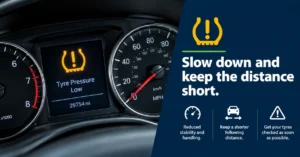
Two things matter more than the exact number. First, slow down immediately. The reinforced sidewall is working hard with no air in it, and speed generates heat that destroys it faster. Second, treat the distance as “enough to reach safety or a fitter,” not “enough to carry on your journey.” The clock and the mileage are both against you once the warning shows.
So if your pressure warning comes on and you have run-flats, the plan is simple: ease off the accelerator, drop to a safe lower speed, and get somewhere you can deal with it, either home or by calling a fitter. Do not treat a run-flat as a licence to keep driving normally.
Can Run-Flat Tyres Be Repaired?
Usually not, and this catches a lot of owners out.
Once a run-flat has been driven on while deflated, the reinforced sidewall has done exactly what it was designed to do, carry the car with no air, and in doing so it typically suffers internal structural damage. That damage is invisible from the outside but makes the tyre unsafe to repair. For this reason, most tyre manufacturers and fitters advise replacing a run-flat that has run flat, not repairing it.
There is a narrow exception. If a run-flat picks up a nail but the pressure monitoring system caught it early and the tyre was not actually driven on flat, a proper inspection might find it repairable within the usual rules. But the moment it has genuinely run flat, replacement is the safe answer. Our guide on whether a punctured tyre can be repaired covers the general repair rules, and run-flats sit at the stricter end of them.
Because a replacement is so often the outcome, and because the car has no spare, having a fitter who carries and fits run-flats matters. That is exactly what our BMW and Mini run-flat fitting is set up for.
The Pros and Cons, Honestly
Run-flats are neither a gimmick nor a magic fix. Here is the fair picture.
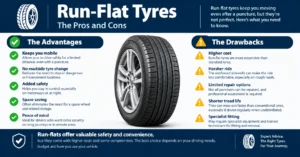
The advantages. You can keep driving after a puncture rather than stopping at the roadside, which is genuinely safer on a motorway. You do not need to change a wheel in a dangerous spot. And with no spare wheel, the car is lighter with more boot space.
The disadvantages. They cost more to buy than standard tyres. They usually cannot be repaired once run flat, so a puncture more often means a new tyre. The ride can feel firmer because of the stiff sidewalls. And crucially, with no spare, if you ignore the warning or drive too far, you can be left with no fallback at all.
Whether they suit you depends on your car and your driving. Many owners simply keep what the car came with, which for a BMW or Mini usually means staying on run-flats. Switching to standard tyres is sometimes possible but removes the drive-on-after-a-puncture safety net and leaves you with no spare, so it is a decision to take on proper advice.
Frequently Asked Questions
How far can you drive on a run-flat tyre after a puncture? As a general guide, most run-flats allow around 50 miles at up to about 50 miles an hour after losing pressure, but the exact limit varies by tyre and is in your handbook. Treat it as enough distance to reach safety or a fitter, not to continue your journey, and slow down immediately.
Can a run-flat tyre be repaired? Usually not. Once a run-flat has been driven on while deflated, its reinforced sidewall typically suffers hidden internal damage that makes repair unsafe, so replacement is advised. The only possible exception is a nail caught very early before the tyre was actually driven on flat, which would need proper inspection.
Do cars with run-flat tyres have a spare wheel? Almost never. The whole purpose of a run-flat is to remove the need for a spare, so cars fitted with them typically carry no spare wheel, only the run-flats themselves. That makes getting a prompt replacement important, since there is no fallback if the run-flat is used up.
Why do run-flat tyres cost more? Their sidewalls are much thicker and reinforced so they can carry the car with no air, which makes them more expensive to manufacture and to fit than standard tyres. This is the main reason a puncture on a run-flat car often costs more than on a standard car, especially as they usually need replacing rather than repairing.
Can I replace run-flats with normal tyres? Sometimes, but with caution. Switching to standard tyres removes the ability to drive on after a puncture, and since run-flat cars carry no spare, you could be left stranded. It can also affect ride and handling. It should only be done on proper advice from a fitter who knows your vehicle.
Conclusion
Run-flat tyres are a clever safety feature: reinforced sidewalls let you drive on for a limited distance, roughly 50 miles at 50 miles an hour as a general guide, after a puncture, so you are not stranded at the roadside. The trade-offs are that they cost more, usually cannot be repaired once run flat, and leave you with no spare to fall back on.
If your run-flat warning has come on, slow down, keep the distance short, and get it dealt with. Our run-flat tyre fitting brings the correct run-flat tyre to you across Glasgow, with the pressure system reset and no call-out fee.