
Executive Summary
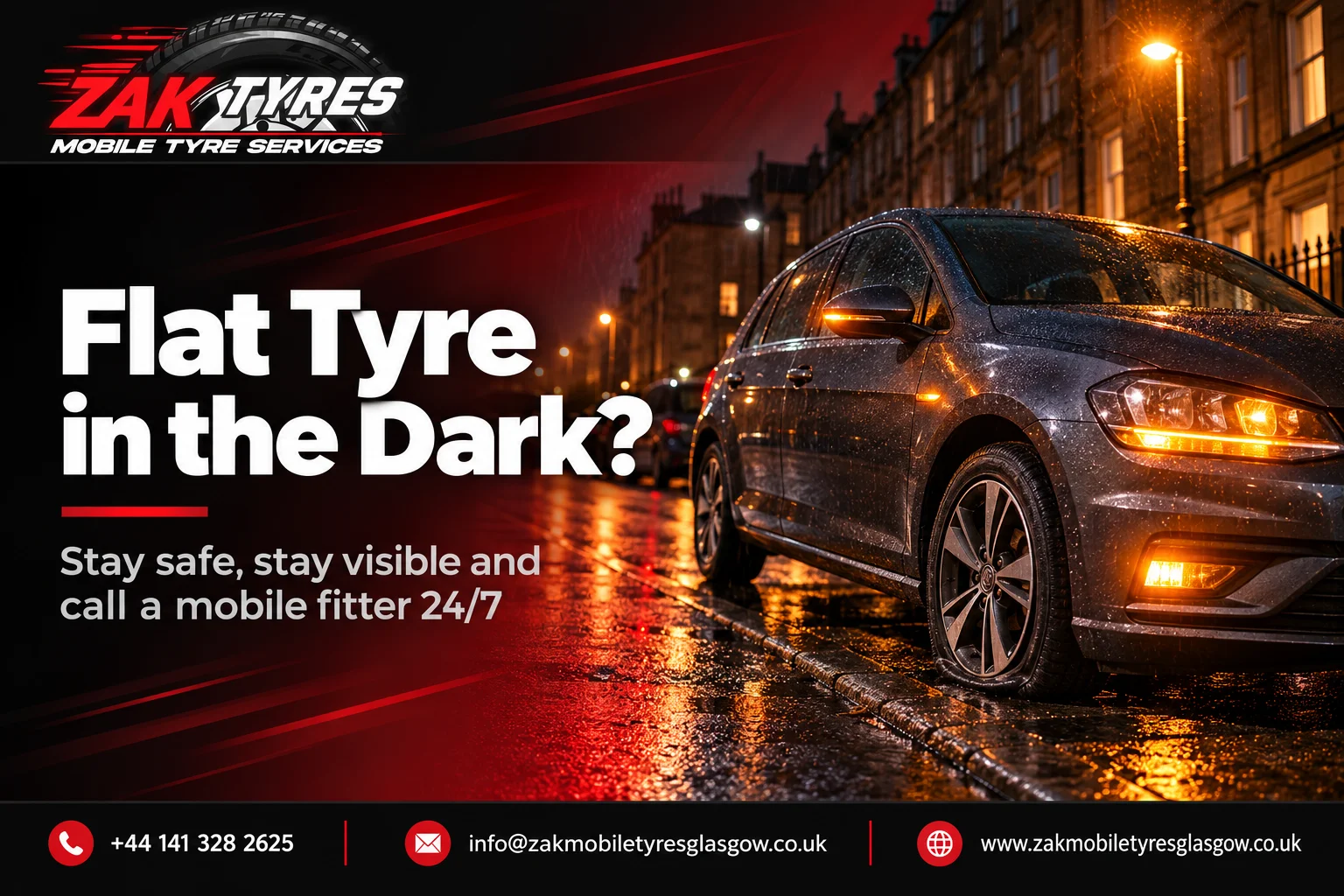
If you get a flat tyre in the dark, the safest thing you can do is stop somewhere lit and away from traffic, switch on your hazard lights, get out on the side away from the road and call for help rather than change the wheel yourself. A tyre is cheap to replace. Being hit while kneeling beside a car on an unlit road is not.
The clocks go back on Sunday 25 October 2026, and from then on most Glasgow drivers will make at least one journey a day in the dark. By the end of October the sun sets before 5pm, and by December it is down before 4pm. That puts the evening commute, the school pick-up and the drive home from the shops into darkness for months.
This guide explains what to do in the first few minutes, where to stop on different roads, how to stay visible while you wait, and what to keep in the boot.
Disclaimer: This article is general safety information. Always follow the Highway Code and any instructions from the police or traffic officers. If you are in danger, call 999.
Why a Flat Tyre Is More Dangerous After Dark
A flat tyre in daylight on a quiet street is a nuisance. The same flat at night carries extra risks that catch people out.
- Other drivers see you later. A stationary car at the side of a dark road is hard to judge, especially in rain, when headlights reflect off wet tarmac and glare hides what is ahead.
- You see less of the damage. It is hard to tell a slow puncture from a torn sidewall by phone torch, so it is easy to drive on when you should not.
- Help takes longer to find. Many garages and tyre shops close by early evening, so drivers try to limp home on a damaged tyre.
- Cold and wet make every job harder. Wheel nuts are tighter, hands are colder, and jacks slip more easily on wet or uneven ground.
What to Do the Moment You Feel a Flat
The signs of a puncture are the same day or night: the steering feels heavy or pulls to one side, there is a flapping or thumping noise, or your tyre pressure warning light comes on. When that happens:
- Hold the steering wheel firmly and keep the car straight. Do not brake hard.
- Ease off the accelerator and let the car slow down gradually.
- Switch on your hazard lights as soon as you start to slow, so drivers behind know something is wrong.
- Look ahead for a safe place to stop: a lit side street, a car park, a lay-by or a petrol station forecourt.
- Pull in as far from moving traffic as you can, on firm, level ground if possible.
- Keep your sidelights on along with your hazards once you have stopped.
If you are only a short distance from a safe spot, it is better to roll there slowly than to stop on a dark bend. Keep the speed very low, because driving any real distance on a flat can damage the wheel as well as the tyre. Our guide on whether you can drive on a flat tyre explains how far is too far.
Where to Stop: Street, Car Park or Motorway
On a lit street or in a car park
This is the best place to be. Park well into the side, away from junctions and bends, and leave room for a fitter to work on the side with the flat tyre. If you can pull into a supermarket or retail park car park, do. They are lit, have space around the car and are easy for a mobile fitter to find. Drop a WhatsApp location pin when you call so the fitter can drive straight to you.
On an unlit road
Rural roads around Strathaven, Lanark, Kilmarnock and the edges of East Kilbride have long stretches with no street lights. Do not stop on a bend or just over the brow of a hill, where approaching drivers will not see you until the last second. If you have to stop, pull as far onto the verge as is safe, keep your lights on, and if it is safe to do so place a warning triangle at least 45 metres behind the car on the same side of the road. Then move away from the car and wait somewhere drivers cannot hit you, such as behind a field gate or well up the verge.
On the M8, M74 or M77
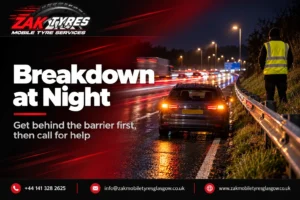
Motorways are the most dangerous place to deal with a flat at any time, and darkness makes them worse. Get onto the hard shoulder or into an emergency area, or leave at the next junction if you can reach it safely. Get everyone out through the left-hand doors, climb over the barrier and wait well up the bank. Do not put a warning triangle on a motorway and do not try to change the wheel. Our guide to a flat tyre on the M8, M74 or M77 covers this step by step, and our guide on changing a tyre on the motorway explains what the Highway Code says.
How to Stay Seen While You Wait
Once the car is stopped, your job is to be visible and to stay out of the way of traffic.
- Keep your hazard lights and sidelights on the whole time.
- Wear a hi-vis vest if you have one. Reflective clothing is far easier to see in headlights than a dark winter coat.
- Use a torch, not just your phone screen, so you can see where you are stepping and drivers can see you.
- Never stand between your car and the traffic, or directly behind the car where you could be trapped if it is hit.
- If you feel unsafe because of your location or the people around you, stay in the car with the doors locked and call 999.
Should You Change the Wheel Yourself at Night?
On a quiet driveway with good light, a confident driver with a proper spare can change a wheel. At the side of a road in the dark, it is usually a bad idea.
You are working low down, often with your back to traffic. The jack may sit on uneven or wet ground. Wheel nuts on many modern cars are tightened hard and are difficult to undo by hand, and if your car has a locking wheel nut you will also need the key. Our guide on what to do if you have lost your locking wheel nut key is worth reading before you ever need it.
There is also a good chance you have no spare at all. Many newer cars carry only a sealant kit, which will not fix a sidewall cut or a large hole. If that is your car, see our guide on what to do with no spare wheel.
For most people, the safer choice at night is to stay clear of the car and let a mobile fitter bring the right tyre and the right tools to you.
What to Tell the Fitter When You Call
A few details help a fitter reach you faster and bring the right tyre on the first visit:
- Your exact location. A WhatsApp location pin is best, especially on unlit roads with no house numbers.
- Your tyre size from the sidewall, for example 205/55 R16, or your registration number.
- Which tyre is flat and what you can see, such as a nail in the tread or a split in the side.
- Whether you have locking wheel nuts and the key.
- Whether you are somewhere safe to wait or need help quickly.
Zak Mobile Tyres Glasgow runs a 24/7 emergency mobile tyre service across Glasgow and Central Scotland. A fitter answers the phone, gives you the price before setting off, and there is no call-out fee within 2km of our Polmadie base. If the tyre can be repaired safely, we will repair it with a mobile puncture repair. If it cannot, we fit a new one at the roadside.
A Night-Time Tyre Kit for the Boot
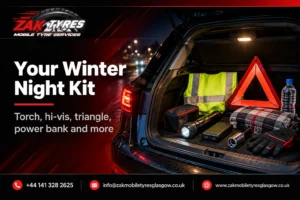
It takes ten minutes to put together a small kit that makes a dark-evening puncture much easier to handle:
- A hi-vis vest for every regular adult passenger
- A bright torch or head torch with spare batteries
- A phone charger or power bank
- A warning triangle, for use off the motorway only
- A warm layer, gloves and a blanket
- Bottled water and a snack
- Your locking wheel nut key, kept in the same place every time
- A note of your tyre size and our number, 0141 328 2625
Check Your Tyres Before the Dark Evenings Start
The best way to avoid a flat in the dark is to catch problems in daylight. Once a week, walk round the car and look for nails, cuts and bulges, and check that no tyre looks lower than the others. Check the pressures monthly when the tyres are cold, because cold weather lowers tyre pressure. Our 7-step winter tyre checks explain exactly what to look for, and our free Tyre Checker helps you decide whether a tyre is safe to drive on.
If your tread is close to 3mm, or a tyre keeps losing air, sort it before the dark nights set in. Our mobile tyre replacement service fits new tyres on your driveway or at work, so you do not have to find a free hour at a garage.
Frequently Asked Questions
What should I do if I get a flat tyre at night?
Slow down gradually, put your hazard lights on and stop somewhere lit and away from traffic. Get out on the side away from the road, keep your sidelights on, and call a mobile tyre fitter or breakdown service. Avoid changing the wheel yourself at the roadside in the dark.
Is it safe to change a tyre in the dark?
It is only reasonably safe on private ground such as a driveway with good lighting. At the roadside in the dark, other drivers may not see you in time, so it is safer to wait away from the car and let a professional do the work.
When do the clocks go back in 2026?
The clocks go back one hour at 2am on Sunday 25 October 2026. After that, sunset in Glasgow is before 5pm, and by December it is before 4pm, so most evening journeys are in the dark.
Where should I wait after a breakdown on the motorway at night?
Leave the car through the left-hand doors, climb over the safety barrier and wait well up the bank, away from the traffic. Do not stand behind the car and do not try to change the wheel. If you are stuck in a live lane, stay in the car with your seatbelt on and call 999.
Can a mobile tyre fitter come out at night in Glasgow?
Yes. Zak Mobile Tyres Glasgow is open 24 hours a day, 7 days a week. We agree the price on the phone before setting off, and there is no call-out fee within 2km of our base in Polmadie.
Conclusion
A flat tyre at night is more dangerous than the same flat in daylight, because other drivers see you later and you see less. Slow down gradually, stop somewhere lit and away from traffic, keep your lights on, stay clear of the car and let a fitter come to you. A little preparation, a hi-vis vest, a torch and a quick tyre check before the clocks change, makes the dark months much easier.
Stuck with a flat after dark? Call 0141 328 2625 or WhatsApp 07553 352305 with your location pin. Our fitters cover Glasgow and Central Scotland 24/7, with no call-out fee under 2km. You can also get a quick quote online.