
Executive Summary
If you drive in Glasgow for long enough, you will hit a pothole. The question is whether your tyre survived it. Pothole tyre damage in Glasgow is one of the most common reasons drivers call us out, and it is often hidden. A tyre can look completely normal from the outside while its internal cords are broken, which is why a hard hit deserves a proper check.
This article explains how potholes damage tyres, the warning signs that matter, a simple post-impact checklist, what you can and cannot repair, how to report a pothole, and when to call a mobile tyre fitter. Everything here is written to help you stay safe first and keep your costs down second.
Why Potholes Are So Hard on Tyres
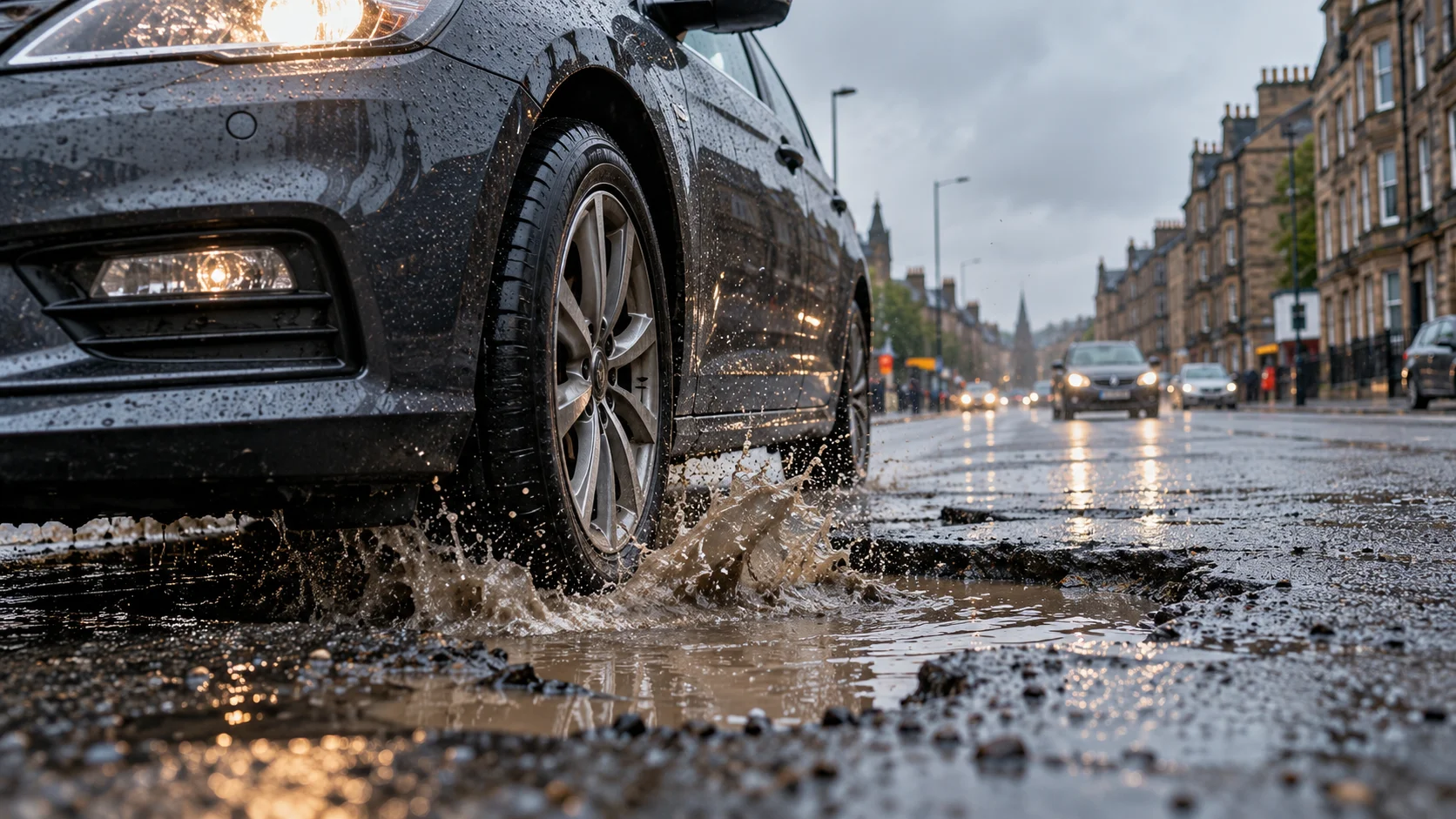
Potholes form when water seeps into cracks in the road surface, freezes, expands, and breaks the surface apart. Scotland’s wet, cold winters make this a recurring problem, and the freeze-thaw cycle through the colder months is when roads deteriorate fastest. A pothole is essentially a sharp-edged hole. When your tyre drops in and then strikes the far edge, the sidewall is squeezed between that edge and the wheel rim. This is called a pinch impact, and it is the main cause of pothole damage.
The harder and faster you hit, the more force goes through the tyre. Low tyre pressure makes it worse, because a soft tyre has less air cushion and flattens more easily against the rim. Low-profile tyres, which have a thin sidewall, are the most vulnerable of all.
The Types of Damage a Pothole Can Cause
Sidewall bulge or bubble
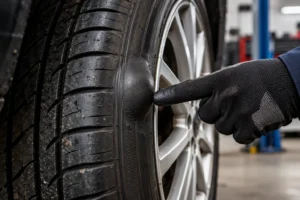
This is the classic pothole injury. The impact breaks the internal cords that give the tyre strength. Air then pushes the weakened section outward, forming a bulge. It is dangerous because the tyre can fail suddenly at speed. A bulged tyre must be replaced and cannot be repaired.
Cuts and sidewall splits
The sharp edge of a pothole, or debris inside it, can slice the rubber. Even a small cut in the sidewall can grow quickly under load. Sidewall cuts are not repairable.
Immediate or slow puncture
Debris in the hole, such as stones, glass or metal, can puncture the tread. If the damage is in the central tread area and the tyre has not been driven flat, it may be repairable. Our mobile puncture repair service can inspect and repair these on the spot.
Bent or cracked wheel
A hard hit can bend the rim. A bent wheel may leak air slowly at the bead, cause vibration and wear the tyre unevenly. Alloy wheels can also crack.
Misalignment and suspension damage
Even if the tyre and wheel survive, the impact can knock your tracking out or damage a shock absorber, ball joint or track rod end. This shows up as the car pulling to one side, a crooked steering wheel or uneven tyre wear.
Warning Signs You Have Pothole Damage
After a hard hit, watch for these signs:
- A bulge or bubble on the sidewall.
- A visible cut, split or tear in the rubber.
- The tyre losing pressure over hours or days.
- A new vibration through the steering wheel or seat, especially at 50 to 70 mph.
- The car pulling to one side.
- A crooked steering wheel when driving straight.
- A knocking or clunking noise over bumps.
- A tyre pressure warning light on the dashboard. If this appears, do not ignore it and have the pressures checked straight away, or contact us for a free tyre check.
If you notice any of these, do not ignore them. They rarely fix themselves.
What to Do Immediately After Hitting a Pothole
- Do not brake sharply or swerve. Stay in control and slow down gradually.
- Pull over somewhere safe as soon as you can. If you are on a fast road, get as far from live traffic as possible. If you are stuck on the motorway, read our guide on changing a tyre on the motorway before doing anything.
- Check the tyre visually. Look at the sidewall and tread for bulges, cuts or deformation. Check the wheel for dents or bends.
- Check the pressure. If the tyre is noticeably soft, do not drive on it.
- Do not carry on if you are unsure. A tyre that looks fine can still be structurally damaged. If you notice vibration, a pull or a pressure loss, stop and get it checked.
- Call for help. If the tyre is flat or damaged, a mobile tyre fitter can come to you instead of you risking the drive. Our roadside tyre assistance covers the M8, M74 and M77.
If the tyre has gone flat, do not try to drive it. Call our emergency mobile tyre fitting team and stay somewhere safe until we arrive.

Can a Pothole-Damaged Tyre Be Repaired?
The honest answer is: sometimes, but less often than people hope.
- Repairable: a simple puncture in the central tread of a tyre that has not been driven flat and shows no internal damage.
- Not repairable: sidewall bulges, sidewall cuts or splits, damage to the tyre shoulder, and any tyre where the internal structure is compromised.
- Run-flat tyres: these are usually not repairable once they have lost pressure and been driven on. Our run-flat tyre fitting page explains why.
If a tyre needs replacing, you can have a new one fitted at your home or workplace through our mobile tyre replacement service. If you need it today, our same day tyre fitting service is often available. Remember that when only one tyre is replaced, it is fitted on the rear axle for stability.
How to Reduce the Risk of Pothole Damage
You cannot avoid every pothole, but you can lower your risk and the damage when you hit one:
- Keep your tyres correctly inflated. The right pressure gives the tyre the best chance of absorbing an impact. Check monthly against the figure in your owner’s manual. Our tyre information page explains how.
- Scan ahead and leave space. Following too closely hides potholes until it is too late.
- Slow down on poor surfaces. Speed multiplies impact force.
- Brake before the pothole, not in it. Braking in the hole loads the front suspension heavily. Ease off and roll through if you cannot avoid it.
- Hold the steering wheel firmly so the impact does not twist it from your hands.
- Avoid puddles on unfamiliar roads. A puddle can hide a deep pothole, especially after heavy rain.
- Check your tread. Worn tyres have less rubber to absorb damage. Use the 20p test and replace at 3mm, as set out on our tyre information page.
- Consider the season. Our winter and seasonal tyre change service helps you prepare for the months when roads break up most, and our tyre guides cover seasonal options in more detail.
Reporting a Pothole and Keeping Evidence
Reporting a pothole helps get it fixed and protects other drivers. Local roads are generally the responsibility of the local roads authority, usually the council, while trunk roads and motorways in Scotland such as the M8, M74 and M77 are managed through Transport Scotland. Most authorities have an online reporting form.
If you want to keep the option of seeking compensation, gather evidence only if it is safe to do so:
- Note the exact location, date and time.
- Take photos of the pothole, including something for scale, and of your damaged tyre and wheel.
- Keep receipts for any repair or replacement.
- Get a written description of the damage from a tyre professional.
Whether a claim succeeds depends on the circumstances and the authority involved, so treat this as general guidance and not as a guarantee.
Pothole Damage Across Glasgow and Central Scotland
Potholes do not respect postcodes. We attend pothole-related tyre failures across the whole region, from the city streets of Springburn, Govan and Castlemilk to the rural lanes around Lanark, Strathaven, Cumbernauld and Bearsden, and across Hamilton, Motherwell and East Kilbride. Rural roads in particular have rough verges and edges that damage tyres. If you are stuck, our emergency mobile tyre fitting team can reach you around the clock.
Disclaimer
This article is general safety and information only. It is not formal legal advice or a substitute for a professional inspection. If you think a tyre is damaged, do not drive on it and have it checked by a qualified tyre technician. Rules on reporting and claims vary by road and authority.
Frequently Asked Questions
Can a pothole damage a tyre without it being obvious?
Yes. A pothole impact can break the internal cords of a tyre without leaving a visible mark on the tread. The first sign is often a bulge on the sidewall, a slow pressure loss or a new vibration. If you hit a deep pothole hard, have the tyre inspected even if it looks fine.
Is a bulge in the sidewall after a pothole dangerous?
Yes. A sidewall bulge means the internal structure of the tyre has failed and air is pushing against the outer rubber. It can burst without warning. A tyre with a bulge cannot be repaired and must be replaced straight away.
Can a pothole-damaged tyre be repaired?
Only in limited cases. Punctures in the central tread can often be repaired, but sidewall damage, bulges and cuts cannot be safely repaired and the tyre must be replaced.
How do I report a pothole in Glasgow?
Report potholes on local roads to the relevant roads authority, usually the local council. Motorways and trunk roads such as the M8, M74 and M77 in Scotland are managed through Transport Scotland. Note the exact location and take photos if it is safe to do so.
Who do I call if a pothole has wrecked my tyre?
Get to safety first, then call a mobile tyre specialist. Zak Mobile Tyres Glasgow provides 24/7 emergency tyre fitting and roadside tyre assistance across Glasgow and Central Scotland with no call-out fee.
Conclusion
A pothole is not just a bump in the road. It can quietly break a tyre from the inside and turn a normal drive into a blowout days later. If you have hit a hard one, check for bulges, cuts, pressure loss and vibration, and never carry on driving a tyre you are not sure about. A tyre can be replaced, you cannot.
Think a pothole has damaged your tyre? Call 07553 352305 now. Our 24/7 mobile tyre fitters come to you anywhere in Glasgow and Central Scotland with no call-out fee, or get a free quote online.