

Executive Summary
For any business that relies on vehicles, tyres are not a minor cost. They are the only part of the vehicle in contact with the road, and when one fails the van stops earning. Effective van tyre maintenance in Glasgow means more than replacing tyres when they burst. It means regular checks, correct pressures for the load, the right commercial tyre for the job, and a plan that keeps downtime as close to zero as possible.
This article is written for tradespeople, courier drivers, delivery businesses and fleet managers. It covers the legal requirements, what makes van tyres different from car tyres, a practical inspection routine, how to record and plan replacements, and how on-site mobile fitting protects your schedule and your costs.
Why Tyre Maintenance Matters More for Vans
A van works harder than a car. It carries heavier loads, stops and starts more often, mounts kerbs on delivery rounds and often runs high mileage across the M8, M74 and M77 and through city streets. All of this wears tyres faster and punishes them harder.
Poor tyre maintenance has direct business costs:
- Breakdowns and missed jobs, which cost revenue and customer trust.
- Higher fuel use, because under-inflated tyres create more rolling resistance.
- Shorter tyre life, as uneven wear forces early replacement.
- Safety risk to your driver and other road users, especially with a loaded van.
- Legal exposure, because defective tyres can lead to fines and penalty points.
A small, regular routine costs a fraction of one unplanned roadside failure.
What the Law Says About Van Tyres
In the UK, a van or light commercial vehicle up to 3,500kg must have a minimum tread depth of 1.6mm across the central three-quarters of the tread, around the entire circumference. That is the same standard as a car. Heavier vehicles over that weight have a different minimum, so check the rules for your category.
Other legal points to remember:
- Tyres must be suitable for the vehicle and its use, with the correct load index and speed rating.
- They must be free from serious cuts, bulges and tears, and not have exposed cords.
- They must be correctly inflated.
- You must not mix certain tyre types, such as radial and cross-ply, on the same axle.
Driving with an illegal tyre can lead to a fine of up to £2,500 and three penalty points per tyre, and for a business owner or operator there can be wider consequences. As a rule of thumb, we recommend replacing at 3mm rather than waiting for 1.6mm, because stopping distances on wet Scottish roads increase significantly as tread wears down. Our tyre information page covers the basic checks every driver should know.
How Van Tyres Differ From Car Tyres
Load rating
Van tyres, often called commercial or “C” tyres, have a reinforced construction to cope with heavier loads. They are usually identified by a C after the rim size, and a double load index such as 107/105, which refers to single and twin fitment. Fitting a standard car tyre to a van is unsafe and often illegal.
Higher pressures
Vans typically need higher pressures than cars, and often different pressures depending on whether the van is laden or empty. The correct figures are in the owner’s manual or on a sticker, usually inside the driver’s door frame. Running a loaded van at an empty-van pressure overheats the tyre and risks failure.
Construction and wear
Commercial tyres are designed for durability, but the weight they carry and the stop-start nature of van work still wear them quickly. Front tyres on front-wheel-drive vans, which handle steering, drive and braking all at once, tend to wear first.
Reading the sidewall
All the key information is on the sidewall: size, load index and speed rating. If you need help decoding it, see our tyre information page.
A Practical Tyre Inspection Routine for Vans and Fleets
Daily: the driver’s walkaround
Every driver should take a minute before setting off to look at each tyre. They are checking for:
- Obvious low pressure, such as a tyre that looks squashed.
- Cuts, bulges or lumps in the sidewall.
- Objects in the tread, such as nails, screws or stones.
- Damage to the wheel or missing valve caps.
- Anything unusual since the last trip.
Weekly: pressures
Check pressures with a reliable gauge when the tyres are cold, and adjust for the load being carried. If your vans have a pressure monitoring system, do not ignore a warning light. Never ignore it: have the pressures checked straight away, or contact us for a free tyre check.
Monthly or at set intervals: full inspection
At least monthly, check:
- Tread depth across the whole width, using a gauge or the 20p test for a quick indication.
- Uneven wear, which suggests alignment, suspension or pressure issues.
- Tyre age. Look for the four-digit date code on the sidewall. Tyres age even when they are not heavily used, and a tyre that is five to six years old should be inspected closely regardless of tread.
- Spare wheel or repair kit, if your van carries one.
- Wheel nuts, to ensure none are loose or missing.
Always: record it
Keep a simple log for each vehicle with the date, pressures, tread readings, findings and action taken. Records show you have taken reasonable care, help you spot patterns and let you plan spending instead of reacting to emergencies.

Warning Signs Your Van Tyres Need Attention
Do not wait for a failure. Act when you see:
- Tread near 3mm.
- Uneven wear, such as a worn inner or outer edge.
- Cracks in the sidewall or tread grooves.
- Bulges or blisters.
- Frequent pressure loss from one tyre.
- Vibration or pulling while driving.
- Tyres older than five to six years, even with good tread.
Rapid or one-sided wear is a sign something mechanical needs checking, since a problem with tracking or suspension will keep chewing through tyres until it is fixed.
Repair or Replace on a Commercial Vehicle?
Many van punctures can be repaired safely if the damage is in the central tread area and the tyre has not been driven flat. A proper repair, where the tyre is removed and inspected from the inside, is far better than an external plug. That said, sidewall damage and tyres that have been run flat usually need replacing. Our mobile puncture repair and mobile tyre repairing services can assess this on site so you only replace what you must.
The Downtime Problem: Why Mobile Fitting Suits Fleets
The biggest hidden cost in fleet tyre management is not the tyre. It is the lost working time. Taking a van to a garage can remove it from the road for half a day or more, plus the driver’s time and the fuel to get there.
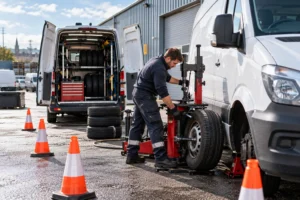
On-site mobile fitting removes most of that:
- We come to your depot, yard or workplace, so vehicles do not have to travel.
- Work can be scheduled around your shifts, including early mornings, evenings and weekends.
- Several vehicles can be done in one visit, with minimal disruption.
- Emergency cover is available around the clock for breakdowns on the road.
- Clear, upfront pricing with no call-out fee makes budgeting simpler.
Our dedicated fleet and van tyre services are built around exactly this. If a van fails on the road, our 24/7 emergency mobile tyre service and roadside tyre assistance can reach it on the M8, M74 or M77 without you needing breakdown membership. And remember, never try to change a tyre yourself beside live traffic. Our guide on changing a tyre on the motorway explains why.
Planning Replacements and Controlling Costs
Reactive tyre spending is expensive. A little planning goes a long way:
- Track wear per vehicle so you know when each tyre is approaching 3mm.
- Replace in pairs on the same axle wherever possible, to keep handling balanced.
- Standardise tyre sizes and brands across the fleet where you can, which simplifies ordering and stock.
- Choose by cost per mile, not purchase price. A better tyre that lasts longer and uses less fuel often wins.
- Fix the cause of uneven wear instead of just replacing the tyre.
- Repair what is repairable and replace what is not.
- Book routine work in advance. Planned fitting through our mobile tyre fitting and mobile tyre replacement services is cheaper and less disruptive than an emergency. Our prices are fully fitted with no call-out fee, so budgeting is simple.
- Plan for the seasons. Our winter and seasonal tyre change service and our tyre guides help you prepare for cold, wet and icy conditions.
- Watch the roads. Potholes damage commercial tyres too. Make sure drivers know what to do after a hard impact: stop somewhere safe, check for bulges and pressure loss, and call us if in doubt.
- Keep the locking wheel nut key with the vehicle. If a key goes missing, we can remove locking wheel nuts on site.
Who We Serve
We work with sole traders, trades businesses, courier and delivery firms, taxi operators and fleet managers across Glasgow and Central Scotland. We attend depots and yards across Springburn, Govan, Cambuslang, Hamilton, Motherwell, East Kilbride, Paisley, Lanark, Strathaven, Cumbernauld and Bearsden, and wherever your drivers happen to be stopped. Not sure about your area? Contact us.
Disclaimer
This article is general information for businesses and is not formal legal or compliance advice. Operator responsibilities, load ratings and legal minimums vary by vehicle weight and type. Always follow your vehicle manufacturer’s guidance and take advice for your own circumstances.
Frequently Asked Questions
How often should van tyres be checked?
Van tyres should be given a quick visual check by the driver before every journey or at least daily, with pressures checked at least weekly and a full inspection of tread depth and condition on a regular schedule. Vans carry loads, so pressures matter more than on a typical car.
What is the legal minimum tread depth for a van?
For vans and light commercial vehicles up to 3,500kg the legal minimum is 1.6mm across the central three-quarters of the tread, the same as a car. Replacing earlier, at around 3mm, is recommended for safety and braking performance.
Do vans need special tyres?
Most vans need load-rated commercial tyres, which are built with reinforced construction to carry heavier loads. They are usually marked with a C or a double load index on the sidewall. Always fit the size, load index and speed rating specified for your vehicle.
Can you fit fleet tyres at our depot?
Yes. Zak Mobile Tyres Glasgow can attend your depot, yard or workplace car park across Glasgow and Central Scotland to fit tyres, repair punctures and carry out checks without taking vehicles off the road for long.
What should a fleet tyre inspection include?
Tread depth across the tyre, sidewall cuts and bulges, correct pressure, uneven wear, foreign objects in the tread, valve and cap condition, and the condition of the wheel. Any findings should be recorded and acted on.
Conclusion
Good van tyre maintenance in Glasgow is really about control: knowing the condition of every tyre, fixing small problems early and keeping your vehicles on the road instead of in a queue at a garage. A simple inspection routine, the right commercial tyres, correct pressures for the load and a mobile partner who comes to your depot will cut downtime, lower costs and keep your drivers safe.
Want your fleet looked after on site? Call 07553 352305 or request a quote today. We come to you across Glasgow and Central Scotland, 24/7, with no call-out fee.