
Executive Summary
Uneven tyre wear is almost always a sign that something else needs fixing. The pattern on the tread tells you what: wear on both edges points to low pressure, wear down the centre points to too much pressure, wear on one edge points to wheel alignment, and patchy dips around the tyre point to balancing or worn suspension. Fix the cause and new tyres last much longer; replace the tyres without fixing it and the new ones wear out the same way.
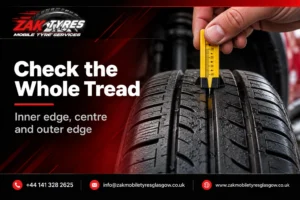
Checking takes a few minutes. Turn the steering to full lock so you can see the front tyres, and compare the inner edge, the centre and the outer edge of each tread by eye and by hand. Any part that is noticeably lower or smoother than the rest is worth acting on.
This guide walks through the common wear patterns, what causes each one, how to fix it, and when a worn tyre has to be replaced. It is written for Glasgow drivers, where potholes, speed bumps and tight kerbside parking make some of these problems more common.
Disclaimer: This article is general information. Wear patterns can have more than one cause, including suspension and steering faults. If you are unsure, have the car checked by a qualified technician.
Why Even Wear Matters
A tyre is designed to wear evenly across its width. When it does, you get the full life out of it and the same grip from edge to edge. When it wears unevenly, three things happen.
First, the tyre reaches the legal limit early. The law requires at least 1.6mm of tread across the central three-quarters of the tyre, all the way round. If one area wears down to that limit, the whole tyre is illegal, even if the rest of the tread looks healthy.
Second, grip drops where you need it. On wet roads, worn areas cannot clear water as well, which increases stopping distances and the risk of aquaplaning.
Third, the cause keeps costing you money. Wrong pressures raise fuel use, poor alignment drags the tyres along the road, and worn suspension parts get worse over time.
How to Check Your Tyres for Uneven Wear
You do not need any tools to spot most wear problems:
- Park on level ground and turn the steering to full lock so the front tyres are easy to see.
- Look across the tread from the inner edge to the outer edge. Note any area that looks lower, smoother or shinier.
- Run your flat hand across the tread in both directions. Feathered or saw-tooth wear feels smooth one way and rough the other.
- Check a few points around each tyre, not just the part you can see. Roll the car forward a metre and look again.
- Use a 20p coin or a tread depth gauge in the inner, centre and outer grooves and compare the readings.
- Compare front tyres with rear tyres, and left with right.
Our free Tyre Checker will help you decide whether what you find is safe to drive on.
The Common Wear Patterns and What They Mean
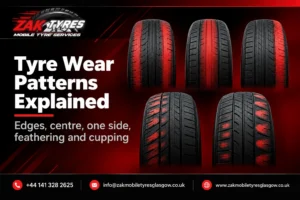
Both edges worn, centre fine
Cause: the tyre has been running underinflated. With too little air, the centre of the tread lifts slightly and the edges carry the load.
Fix: check the pressures when the tyres are cold, using the figures in your handbook or on the sticker inside the driver’s door, and set them correctly. Check monthly, because cold Scottish weather lowers pressure. If one tyre keeps losing air, it may have a slow puncture or a leaking valve, which a mobile puncture repair can usually sort.
Centre worn, edges fine
Cause: the tyre has been running overinflated. Too much air makes the centre bulge slightly, so it carries more of the load.
Fix: let the pressure down to the correct figure. This is less common than underinflation but often happens when drivers use the maximum pressure printed on the sidewall instead of the car maker’s recommended figure.
One edge worn, inside or outside
Cause: wheel alignment is out. Toe or camber settings that do not match the car maker’s figures push the tyre over onto one shoulder. Inner-edge wear is the most common pattern and is easy to miss, because you cannot see it without turning the wheel or kneeling down.
Fix: book a wheel alignment check. If camber is out and cannot be adjusted, a suspension part may be bent or worn and will need a garage. Our guide to wheel balancing vs wheel alignment explains the difference between the two services.
Feathered or saw-tooth wear
Cause: the tread blocks wear at an angle, so the tyre feels smooth when you run your hand one way and sharp the other. This is a classic sign of a toe setting that is out.
Fix: an alignment check, usually toe adjustment. Feathering is often felt before it is seen, so the hand test is worth doing.
Cupping or scalloping
Cause: dips appear at regular intervals around the tyre, like scoops taken out of the tread. This usually means the wheel is bouncing as it rolls, because of worn shock absorbers or suspension parts, or an unbalanced wheel. Cupped tyres often make a rhythmic humming noise that gets louder with speed.
Fix: have the wheel balance checked first, then the shock absorbers and suspension. Replacing the tyre without fixing the bounce means the new one will cup too.
A flat spot in one place
Cause: a patch of the tread is worn much flatter than the rest, usually after the wheel locked under heavy braking and skidded. Cars left parked for months can also develop temporary flat spots.
Fix: a skid flat spot is permanent and often causes vibration. If it goes through the tread pattern or shows any cords, the tyre needs replacing.
One tyre much more worn than the others
Cause: on front-wheel-drive cars, which is most cars on Glasgow’s roads, the front tyres handle steering, braking and drive, so they naturally wear faster than the rears. A single tyre that is far more worn than its partner on the same axle can also point to a sticking brake or an alignment problem on that side.
Fix: many handbooks suggest rotating tyres front to rear at regular intervals to even out wear. Check your handbook first, because some cars have different sizes front and rear or directional tyres that should only be moved in certain ways.
Glasgow Roads and Uneven Wear
Some local habits and conditions make uneven wear more likely:
- Potholes. A hard strike can move the alignment, bend a rim or damage a shock absorber. Our guide to pothole tyre damage in Glasgow explains what to check afterwards.
- Speed bumps. Taking them quickly, or with one wheel on the bump, loads the suspension and steering.
- Kerbing. Tight on-street parking means frequent knocks against kerbs, which can damage the sidewall and move the tracking.
- Cold, wet weather. Pressures drop as temperatures fall, so underinflation wear builds up over the winter if pressures are not topped up.
When Uneven Wear Means a New Tyre
Fixing the cause stops the wear getting worse, but it cannot put rubber back. Replace the tyre if:
- Any part of the central three-quarters of the tread is at or below 1.6mm
- Cords or wires are showing anywhere on the tread or shoulder
- The worn area has cracks, bulges or splits
- The tyre vibrates badly because of cupping or a flat spot
We recommend replacing at around 3mm for winter driving, because wet grip drops noticeably below that. When a tyre does need replacing, our mobile tyre replacement service fits a new one at your home or work, from £95 supplied and fitted, with balancing included. If the old tyre wore unevenly, ask us to check the alignment at the same time so the new tyre lasts.
For more on the legal side, see our UK tyre legal checklist.
How to Prevent Uneven Tyre Wear
A few simple habits keep wear even and make tyres last longer:
- Check tyre pressures monthly and before long trips, with the tyres cold.
- Look at the tread across its full width every few weeks.
- Get the alignment checked once a year, after any hard impact, and when fitting new tyres.
- Make sure every new tyre is balanced when it is fitted.
- Rotate tyres if your handbook recommends it.
- Slow down for potholes and speed bumps, and avoid hitting kerbs when parking.
- Have worn shock absorbers and suspension parts replaced when a garage advises it.
Frequently Asked Questions
What causes tyres to wear on the inside edge?
Inside-edge wear is usually caused by wheel alignment that is out, most often the toe or camber setting. It is easy to miss because you can only see it by turning the steering to full lock or kneeling down. An alignment check will confirm the cause.
What does it mean if both edges of my tyre are worn?
Wear on both edges with the centre still in good condition usually means the tyre has been running underinflated. Check and correct the pressures monthly, and have the tyre checked for a slow puncture if it keeps losing air.
Can uneven tyre wear be fixed?
The cause can be fixed, for example by correcting pressures, alignment or balance, which stops the wear getting worse. The worn rubber cannot be restored, so if any part of the tread is close to the legal limit the tyre needs replacing.
Is uneven tyre wear an MOT fail?
It can be. If any part of the central three-quarters of the tread is below 1.6mm, or cords are exposed, the tyre fails the MOT and is illegal to drive on, even if the rest of the tread looks fine.
Should I get an alignment check when I buy new tyres?
Yes, especially if your old tyres wore unevenly. Fitting new tyres to a car with poor alignment means they will wear unevenly too, often within a few thousand miles.
Conclusion
Uneven tyre wear is a warning sign worth reading. Edge wear on both sides points to low pressure, centre wear to high pressure, one-edge or feathered wear to alignment, and cupping to balance or suspension. Fix the cause first, then replace any tyre that is close to the legal limit, and the next set will last much longer.
Spotted uneven wear? Call 0141 328 2625 or WhatsApp 07553 352305 with a photo of the tread. We can check, balance, align and replace tyres at your home or work across Glasgow and Central Scotland, with no call-out fee under 2km. You can also get a quick quote online